
Fraud today doesn’t break in. It knocks politely.
Today, my phone rang. The number was +91 6201321966.
The voice on the other end sounded calm, trained, and almost courteous.
“Ma’am, aapke address par courier delivery hai. Delivery boy aapke ghar ka address nahi dhoondh pa raha. Aap usse directly call kar lo aur apna courier le lo.”
Nothing alarming. No pressure. No drama.
That’s exactly what made it dangerous.
I asked a simple question.
“Which address?”
The reply came smoothly.
“Address delivery boy ke paas hai. Main office mein hoon, mujhe nahi pata.”
That was the first crack.
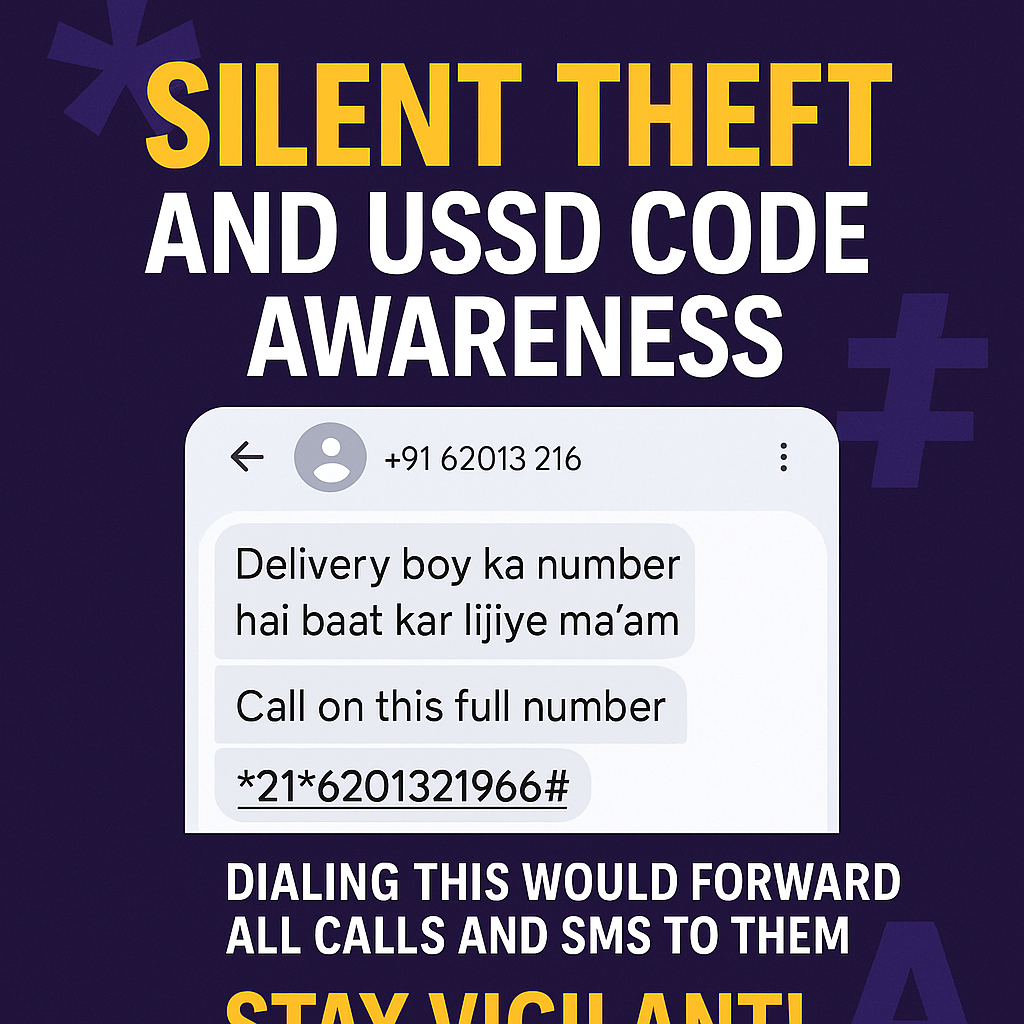
Then he offered a solution. He would SMS me the delivery boy’s number.
The message came in seconds.
It wasn’t a phone number.
It was *21*His Number#.
One asterisk was enough to stop me cold.
Anyone who understands basic telecom systems knows this: *21* is not random. It’s a USSD command. When dialed, it forwards all calls and SMS unconditionally to another number.
Including bank OTPs.
Including verification alerts.
Including the very messages designed to protect your money.
This was not about a courier.
This was about silent access.
A minute later, he called again. Same polite tone.
“Ma’am, aapne delivery boy ko call nahi kiya.”
I replied calmly, “Maine call kar liya.”
Without hesitation, he said, “Nahi, ma’am, aapne call nahi kiya.”
That confidence gave him away.
I told him clearly, “Courier rakh lo. Fraud mat karo.”
The call disconnected instantly.
No shouting.
No threats.
No follow-up.
Because scams like this don’t depend on intimidation. They depend on trust, speed, and lack of awareness.
What almost happened
If someone had dialed that code without knowing what it does, this is what would follow:
All incoming calls would be forwarded to the fraudster.
All SMS, including banking OTPs, would land on his phone.
The victim would continue using their phone, unaware.
Money could disappear without a single “suspicious activity” alert.
No hacking.
No malware.
No stolen phone.
Just one dialed code.
This is how modern fraud works. Quiet. Efficient. Invisible.
The uncomfortable question
We celebrate digitalisation loudly.
UPI milestones. Cashless payments. One-tap banking.
But we rarely ask the harder question:
The Real Question: Are We Digitally Secure—or Just Digitally Fast?
We celebrate digitalisation.
UPI everywhere.
Cashless transactions.
One-click payments.
Instant approvals.
But here is the uncomfortable truth:
Speed without awareness is vulnerability.
Fraud today does not look like crime.
It looks like customer service.
It speaks politely.
It sounds procedural.
It uses urgency and confusion—“office mein hoon,” “delivery boy ke paas hai,” “bas ek call kar dijiye.”
And it targets those who trust systems:
-
Senior citizens
-
Homemakers
-
First-time digital users
-
People who believe, “It’s just a courier call.”
One wrong dial, and the fraud does not steal your money immediately.
It waits.
It listens.
It intercepts your OTPs.
It enters your life silently.
This is bigger than one scam
This isn’t about a courier call.
It’s about how easily system trust can be manipulated.
Telecom codes that users don’t understand.
Financial security that still depends heavily on SMS.
No automatic warning when call forwarding is activated.
Minimal large-scale digital safety education.
We digitised money faster than we digitised judgement.
And in that gap, fraud has found fertile ground.
What everyone needs to know, right now
Please read this carefully and share it.
Never dial codes sent by unknown callers, especially those starting with *21*.
Courier companies do not ask you to dial codes. Ever.
Call forwarding can compromise your bank without touching your phone.
Vagueness is a red flag. Real systems are specific.
Hang up first. Verify later. Always.
A final thought
Sometimes I wonder whether our race towards digital convenience has outpaced our responsibility towards digital safety.
Technology is not the problem.
Ignorance is.
Until awareness moves as fast as innovation,
calls like these will keep coming.
Polite.
Professional.
And quietly dangerous.
If this made you pause, even briefly, share it.
That pause might protect someone’s life savings.