
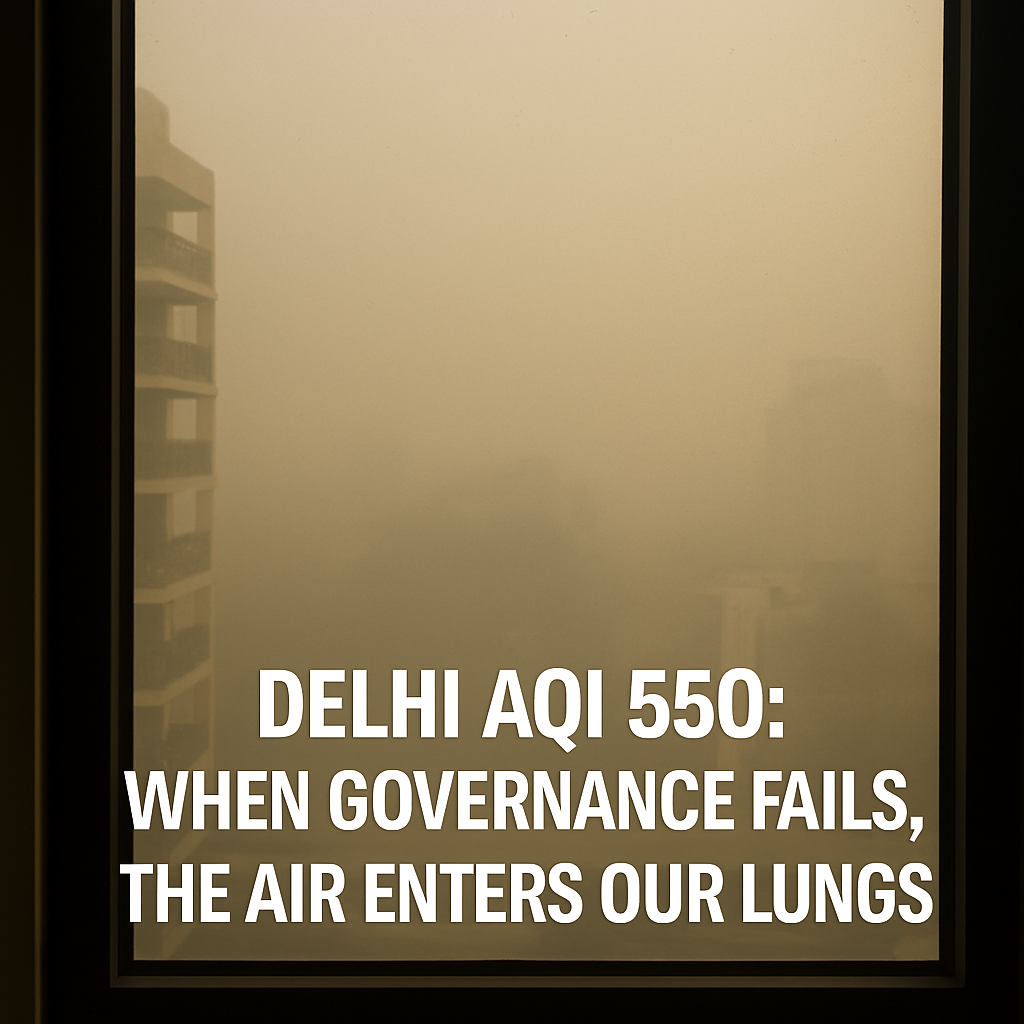
This morning, when the eyes opened, the city outside the window had vanished. Not hidden. Erased. This wasn’t low visibility. It felt like negative visibility, as if someone had rubbed out the horizon and then shaded the air with a thick, poisonous pencil.
The number confirmed what the body already knew.
Delhi’s AQI today: 550.
That first signal didn’t come from the eyes. It came from the neck and chest. A slight burn. A tightness. That familiar Delhi winter discomfort that people usually shrug off as normal. But this time it felt different. Sharper. Heavier. As if the lungs were finally saying, enough.
Being born and brought up in Delhi comes with a strange assumption: that the body adapts. That decades of breathing this air must have toughened the lungs, the way mosquitoes once adapted to DDT. The comforting illusion was simple. If the body is still functioning, maybe it has adjusted.
But if even these DDT-grade Delhi lungs are protesting at AQI 550, then something far more toxic is floating in the air now. A higher-quality poison. Invisible, but deeply intimate, entering with every breath.
And in that moment, personal suffocation connected to a larger truth. Delhi’s air crisis is not seasonal bad luck. It is a long-brewed failure of policy and governance.
From personal discomfort to public policy
That heaviness in the neck isn’t just biology. It is policy, accumulated over years. Decisions about what gets encouraged, what gets tolerated, and what gets ignored.
Explosive growth in private vehicles.
Delays in strengthening public transport.
Construction approvals with weak dust control.
Stubble burning reduced to a political blame game instead of a shared regional solution.
All of it converts neatly into particulate matter. And that particulate matter doesn’t stay abstract. It settles in throats, lungs, bloodstreams.
The air is not an individual lifestyle issue. It is the outcome of regulation choices. Of enforcement gaps. Of violations quietly overlooked because they are inconvenient to confront.
And Delhi’s air is shaped far beyond Delhi. Agricultural policies that make crop burning the cheapest option. Fuel pricing that nudges people toward certain vehicles. Urban planning that loves highways more than walkable neighbourhoods.
When these align in the wrong direction, you don’t get “bad weather.”
You get policy-engineered smog, with an AQI reading of 550.
Why AQI 550 is a governance failure, not a surprise
On paper, India is not short of solutions. Air quality standards exist. So do the National Clean Air Programme and the Graded Response Action Plan. Vehicle emission norms are written. Industrial regulations are notified.
But governance is not about what is written. It is about what actually happens.
What we see instead is governing by emergency. Panic when AQI crosses severe. Schools shut. Construction halted for a few days. Odd-even schemes resurrected. Then, once numbers dip slightly, everyone exhales and returns to business as usual.
Different agencies hold different pieces of the problem. No one owns the outcome.
Delhi blames Punjab and Haryana for stubble.
They point back at Delhi’s vehicles and construction.
And when all else fails, weather becomes the final excuse.
Fragmented authority, weak enforcement, and short political attention spans are what turn a solvable issue into an annual public health disaster measured this morning at AQI 550.
Rights, responsibility, and the right to breathe
That erased skyline is not just emotionally disturbing. It is constitutionally serious.
Indian courts have repeatedly read the right to a clean environment into the right to life. Breathable air is not charity. It is a state obligation.
Multiply that throat irritation across millions of people and you get hospital visits, lost school days, reduced productivity, and premature deaths. These are governance outcomes, not personal failures.
When children cannot play outdoors, elders abandon morning walks, and citizens commute masked like they’re entering an ICU, the issue is no longer about sensitive groups. It is about whether the state is meeting its most basic duty.
In that sense, AQI is not just an environmental indicator.
It is a governance indicator.
Policy vs governance, explained creatively
Think of Delhi’s air crisis as a badly run orchestra. The sheet music exists. The performance does not.
| “Instrument” in the smog orchestra | What the policy claims to play (on paper) | What actually reaches our lungs (in practice) |
|---|---|---|
| Transport | Clean fuels, emission norms, public transport push, EV promotion | Exploding private vehicles, patchy buses and Metro reach, weak enforcement |
| Construction & real estate | Dust management rules, covered materials, strict site norms | Open dumping, uncovered trucks, token sprinkling when cameras appear |
| Agriculture & rural policy | Incentives for residue management, alternatives to stubble burning | Burning remains cheapest; political blame replaces collaboration |
| Urban planning & land use | Compact, transit-oriented development, green buffers | Sprawl, concrete expansion, shrinking tree cover, heat islands |
| Monitoring & data | AQI stations, real-time dashboards, health advisories | Data without decisive action; alerts treated as background noise |
| Enforcement & regulation | Fines, closures, graded response plans | Sporadic crackdowns, short-term bans, long-term impunity |
| Citizen rights & participation | Right to clean air, public hearings, grievance systems | Residents adapt with masks and purifiers instead of policy change |
This morning’s negative visibility at AQI 550 is hyper-visible proof of what happens when policy design and governance execution drift apart.
The body knows before the dashboard does.
Irritated throat. Heavy chest. Mild headache.
These are micro-reports from inside the system, quietly saying: this is no longer just weather. This is governance entering the lungs.
For a city that prides itself on power, culture, and history, the most radical shift now is surprisingly basic. To stop treating clean air as a seasonal crisis to be managed. And start treating it as a non-negotiable public good to be secured, every single day.