
A New Way to Think About Teaching and Learning
We have it backwards. For decades, we’ve talked about teaching as content delivery, with classroom management as the mechanism to maintain control so that teaching can happen. We’ve added mental health support as an afterthought—something counselors do, or something we address when crisis strikes.
But emerging research in neuroscience, learning science, and education tells a radically different story. It’s time to flip the entire framework upside down.
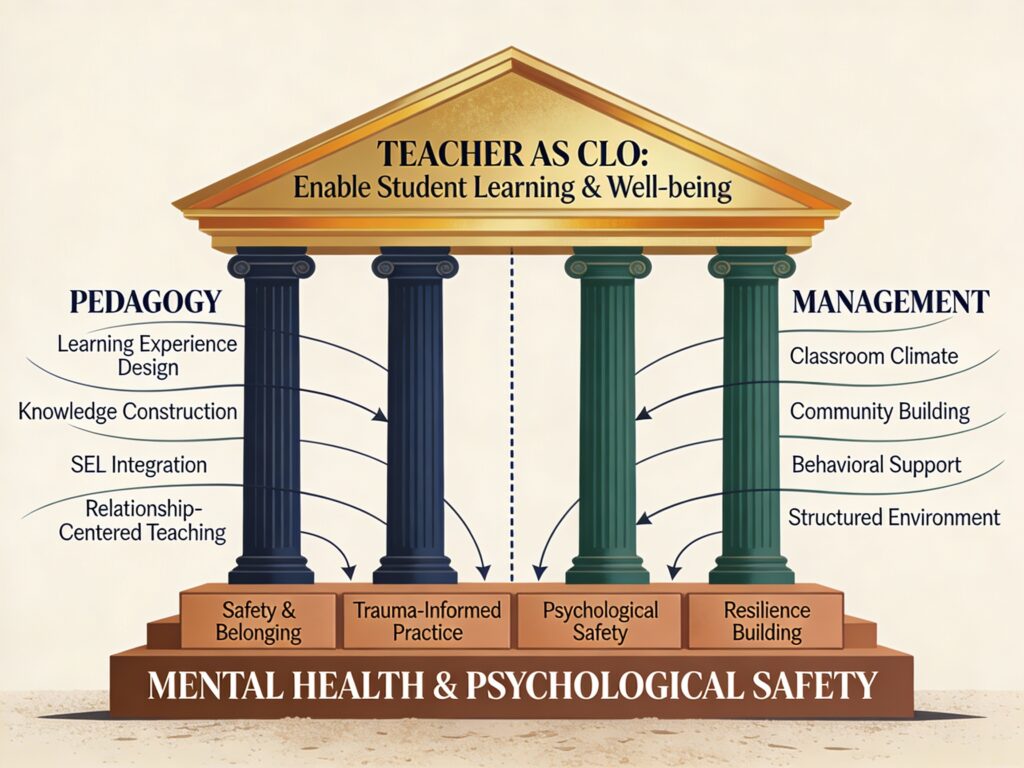
If you want to enable learning—truly enable it, not just deliver content—you need to think like a Chief Learning Officer (CLO). And that means building your classroom on a foundation of mental health and psychological safety, supported by two equal pillars: pedagogy (learning design) and management (learning conditions).
Let me explain why this matters, and how to think about your role differently.
The Problem with “Teaching” as the Goal
I’ve sat in thousands of classrooms. Some teachers stand at the front, expertly delivering content. Students copy notes. Some do the homework. Some pass the test. But ask them a month later what they learned, and much of it is gone. The teacher taught, but the learning didn’t stick.
Other teachers create experiences where students struggle with real problems, discuss ideas with peers, question their thinking, and emerge with understanding that transfers to new contexts. The same content, but transformed through how it’s engaged with.
What’s the difference?
It’s not content knowledge. It’s not instructional tricks. It’s the fundamental reorientation of purpose from “teaching” to “enabling learning.”
When your goal is teaching, you’re focused on what you do. When your goal is enabling learning, you’re focused on what students do—and designing conditions where they can do the cognitive work that produces real learning.
The data backs this up. A longitudinal study of 37,397 students showed that first-grade mental health was one of the strongest predictors of achievement on national tests three years later. But more striking: students whose mental health improved between first and third grade made dramatically better academic progress than students whose mental health stayed the same or worsened. The pathway to learning runs through well-being.
Introducing the CLO Teacher Model
A Chief Learning Officer in a corporation is not an instructor. They don’t deliver training programs. They design learning systems. They understand the organization’s needs, design strategies to develop capability, create conditions where learning can happen, integrate technology thoughtfully, measure what’s working, and build a culture where continuous learning is valued.
What if teachers operated the same way?
The CLO Teacher:
-
Doesn’t deliver curriculum. Designs learning experiences.
-
Doesn’t manage behavior. Creates conditions where students can thrive.
-
Doesn’t add mental health support as extra. Builds everything on mental health as foundation.
-
Doesn’t focus on content coverage. Focuses on deep understanding.
-
Doesn’t work in isolation. Collaborates with colleagues, families, and specialists.
The CLO teacher’s job is simple to state but profound to execute: Enable student learning and well-being.
This job is accomplished through understanding and integrating three interconnected elements:
-
Mental Health & Psychological Safety (Foundation)
-
Pedagogy (Pillar 1: Learning Design)
-
Management (Pillar 2: Learning Conditions)
The Foundation: Mental Health and Psychological Safety
Let’s start here because everything else depends on it.
Your brain—and your students’ brains—cannot learn effectively when in threat-response mode. When a student feels unsafe, when they’ve experienced trauma, when they’re anxious about failure, their amygdala activates and hijacks the prefrontal cortex. The result? Working memory shrinks. Abstract thinking becomes difficult. Learning capacity plummets.
This is not dramatic exaggeration. This is neuroscience.
The mental health foundation has four cornerstones:
1. Safety and Belonging
Your students need to know, not intellectually but viscerally, that they are welcome in your classroom and that they belong there. This isn’t built through posters about inclusion. It’s built through:
-
Welcoming rituals that say “I’m glad you’re here” every single day
-
Collaborative norm-setting that says “We create this community together”
-
Personal attention that shows you know them as individuals
-
Inclusion in decision-making that says “Your voice matters”
-
Peer connections facilitated intentionally, so students feel connected to classmates
When students experience genuine belonging, their nervous system shifts. Safety is activated. The brain becomes available for learning.
2. Trauma-Informed Practice
Some of your students come to school carrying trauma. Violence. Loss. Instability. Poverty. Racism. Displacement. Their nervous systems are calibrated for threat-detection.
A traditional teacher seeing a student act out might think: “This student is disrespectful. Consequence needed.” A trauma-informed CLO teacher thinks: “This behavior is communication. What is this student’s nervous system telling me they need?”
The response is radically different. Instead of punishment (which retraumatizes), the CLO teacher responds with compassionate investigation and support. “I notice you’re upset. What’s happening? How can I help?”
This approach—called “zero indifference” instead of “zero tolerance”—creates space for healing while also teaching students more adaptive responses.
3. Psychological Safety
This is the condition where a student knows they can make a mistake without shame, ask a question without ridicule, struggle without being labeled inadequate, and contribute an idea without fear of judgment.
Psychological safety unfolds in stages:
-
Inclusion safety: “I belong here”
-
Learner safety: “I can struggle and learn; mistakes are okay”
-
Contributor safety: “My ideas matter”
-
Challenger safety: “I can respectfully question and challenge”
You build psychological safety through clarity (about what and why), transparent expectations, vulnerability (admitting your own mistakes), consistency, and celebrating growth over perfection.
In a psychologically safe classroom, students take intellectual risks. They engage in the generative cognitive work that produces deep learning.
4. Resilience and Emotional Capacity
Finally, students need to develop their own emotional resources. This happens when:
-
Struggle is normalized: “All learning involves struggle. That’s not a sign something is wrong; that’s a sign your brain is growing.”
-
Effort is celebrated: “I’m impressed by how hard you worked, regardless of the outcome.”
-
Coping strategies are taught: “Here are tools you can use when things feel hard.”
-
Growth is visible: “Look how much you’ve learned. You’re more capable than you were.”
When students develop resilience, they persist through difficulty. They see setbacks as information, not indictments.
Pillar One: Pedagogy—Learning Design, Not Content Delivery
Now that you’ve built the mental health foundation, the first pillar rises: Pedagogy.
Pedagogy is often misunderstood. It’s not a teaching method. It’s not a lesson plan format. It’s the science and art of designing learning experiences where students actively construct understanding.
What Strong Pedagogy Looks Like
Learning Experience Design
You start with a clear question: What understanding do we want students to construct? Not “What content should I cover?” but “What deep understanding matters?”
Then you design a sequence of learning experiences—perhaps discussion, problem-solving, projects, inquiry, peer teaching, direct instruction, reflection—that bridges from where students currently are to where you want them to be. Each activity is chosen for its capacity to engage students in generative cognitive work: thinking deeply, making connections, testing ideas, refining understanding.
Student-Centered Approach
You design for the students you actually have, not the students you wish you had. You:
-
Build on their prior knowledge and experiences
-
Honor their diverse ways of learning
-
Give them voice and choice where possible
-
Differentiate so each student is appropriately challenged
-
Help them see themselves as capable learners
Social-Emotional Learning Integration
This is where pedagogy directly supports mental health. Five core competencies are woven throughout:
-
Self-awareness: “I understand my emotions and how they affect my thinking”
-
Self-management: “I can regulate my emotions and manage my behavior”
-
Social awareness: “I understand others’ perspectives and appreciate diversity”
-
Relationship skills: “I can collaborate, communicate, and handle conflict”
-
Responsible decision-making: “I can think ethically and consider consequences”
These aren’t taught in a separate “SEL class.” They’re integrated into every subject. A math lesson on collaborative problem-solving builds relationship skills. A literature unit analyzing character emotions builds empathy. A science project requiring teamwork develops all five competencies.
Relationship-Centered Teaching
Here’s what research makes crystal clear: students learn better from teachers they trust and feel known by.
This means:
-
You know your students as whole people, not just learners
-
You design learning in the context of genuine relationship
-
You demonstrate care through attention and responsiveness
-
You communicate authentic belief in their capability
-
You’re willing to be vulnerable about your own learning
When students feel genuinely known and valued, they take the intellectual risks that learning requires.
Knowledge Construction Facilitation
Rather than telling students what to think, you facilitate their thinking:
-
You ask questions that make them think deeper
-
You create problems worth solving
-
You facilitate peer discussion where students think together
-
You help them make connections and see patterns
-
You guide their reflection on their own learning
You’re a guide in their learning process, not the authority with all answers.
Pillar Two: Management—Creating Conditions for Learning, Not Controlling Behavior
The second pillar is Management: the creation of organizational, environmental, and relational conditions where learning thrives.
Management is often seen as negative—”behavior management,” “classroom control.” But reframe it: Management is architecture. You’re architecting the physical space, the procedures, the relationships, the time—creating conditions where learning can flourish.
What Strong Management Looks Like
Classroom Organization
You design your physical space intentionally:
-
Materials are organized so students can find what they need
-
Seating supports collaboration when collaboration is the goal
-
Visual displays celebrate diverse student work and reinforce learning
-
The environment communicates expectations and values
-
Everything supports student independence and reduces unnecessary cognitive load
Positive Climate Building
The emotional tenor of your classroom matters enormously. A positive climate is:
-
Warm and welcoming
-
Humor-filled
-
Celebratory of growth and effort
-
Filled with genuine recognition of contributions
-
Fundamentally affirming
This doesn’t mean permissive. Expectations are clear and high. But students know the teacher genuinely cares and believes in them.
Community Development
You intentionally build a sense of community:
-
Through rituals that create connection (morning meetings, closing circles)
-
By facilitating peer relationships
-
By teaching students to support each other’s learning
-
By creating shared responsibility for the group’s well-being
In a well-developed classroom community, students care about each other’s success. They feel responsibility to contribute positively.
Supportive Behavioral Framework
Here’s where management directly supports mental health. You shift from “zero tolerance” to “zero indifference”—intervening immediately with care rather than immediately with consequence.
When behavior indicates dysregulation:
-
You don’t punish. You investigate.
-
You ask: “What is this student trying to communicate?”
-
You respond with support and teaching, not shame and exclusion
-
You help the student understand their emotions and practice more adaptive responses
-
You repair any harm caused
This approach both supports mental health recovery and teaches lifelong emotional competence.
Structured, Predictable Environment
Students thrive with structure—especially students who’ve experienced trauma or anxiety. You provide:
-
Clear routines and procedures
-
Predictable sequences and transitions
-
Consistent expectations
-
A schedule students can count on
This structure is compassionate architecture, not rigid authoritarianism. It frees students’ nervous systems to relax and their brains to engage in learning.
The Integrating Element: Teacher Mental Health Literacy
Running through your entire practice—connecting the foundation to both pillars—is Teacher Mental Health Literacy: your professional competency for recognizing and supporting student mental health.
This includes:
Knowledge:
-
Understanding how mental health conditions affect learning
-
Recognizing early signs a student is struggling
-
Knowing about positive mental health and well-being
-
Understanding resources and referral processes
Action Competencies:
-
Recognize: When a student is struggling emotionally
-
Assess: What the nature of the struggle is
-
Respond: With supportive conditions and interventions
-
Refer: To specialist mental health support when needed
This competency allows you to weave mental health consideration throughout all your pedagogy and management. When you design a unit, you ask: “How will this support student well-being?” When you respond to behavior, you ask: “What is this telling me about this student’s state?” When you build climate, you ensure every student feels genuinely welcomed.
How It Works in Practice: Three Scenarios
Let me make this concrete.
Scenario 1: A Student Struggling with a Difficult Concept
What you observe: Maya is frustrated trying to solve a multi-step math problem. She’s quiet, withdrawn, not asking for help.
CLO Response – Integrated:
Pedagogical lens: “What’s her prior knowledge gap? Can I design a different entry point? Could peer explanation work better than my explanation?”
Management lens: “Is she overwhelmed by the environment? Does she need less stimulation, more structure, more proximity and encouragement?”
Mental health lens: “Is she anxious about failure? Does she need reassurance that struggle is learning? Can I help her see herself as capable?”
Action: You pull up a chair. “I notice math is feeling hard today. That makes sense—this is a tricky problem. You know what? Your brain is actually growing right now when it’s struggling. Let me show you a different way to think about it…” You redesign the learning experience (pedagogy), provide structure and encouragement (management), and address the anxiety underneath (mental health). Maya learns the math AND learns that struggle is normal AND experiences genuine care.
Scenario 2: A Student Shows Behavioral Dysregulation
What you observe: Jami suddenly gets angry during independent work time. He crumples his paper and walks to the back of the room. His classmates look nervous.
Traditional response: “Jami, that’s not acceptable. You need to calm down right now or you’ll lose recess.”
CLO Response – Integrated:
Mental health literacy: “His behavior is communication. He’s dysregulated. What triggered this? Frustration? Shame? Something else?”
Management: You calmly approach. “I see you’re upset. Let’s get you some space.” You provide a safe spot, maybe a stress ball, water. You don’t demand he return to work immediately.
Once regulated: You have a conversation (pedagogy). “That was hard, wasn’t it? Tell me what happened.” He explains: the problem was too hard, he felt stupid, he got frustrated. You ask: “What could you do next time when you feel frustrated?” Together you identify strategies—asking for help, taking a break, breaking the problem into smaller steps. You’ve taught emotional literacy and coping skills.
Result: Jami feels understood, not punished. He learns emotional competence. Your relationship is deepened. He’s more likely to engage in your classroom community and more willing to tackle challenges.
Scenario 3: Designing a Unit
Traditional approach: Select textbook chapter, create worksheets, assign homework, assess with test.
CLO approach – Integrated:
Pedagogy: You start with the big understanding you want: “What does it mean to be an active citizen in a democracy?” You design learning experiences: students research current issues, discuss in Socratic seminars, collaborate on action projects, present to actual community members. Each activity is chosen to develop understanding.
Management: You plan how to organize materials, how to facilitate collaboration, how to manage the transition between activities, what routines will support student independence. You design the physical space to support group work.
Mental Health: You anticipate which students might struggle. You plan how to build their confidence, how to create an environment where their ideas are valued, how to ensure they feel supported. You integrate emotion and perspective-taking into the content itself.
Result: Students develop deep understanding of citizenship, learn to collaborate and think critically, experience their ideas as valued, develop social awareness by considering diverse perspectives, and see themselves as capable citizens. Learning and well-being happen together.
Why This Framework Actually Works
Let me be clear: this isn’t magical. There’s no silver bullet. But this framework works because it:
It’s Grounded in Learning Science
Neuroscience shows us that safety, relationships, and emotional well-being are prerequisites for learning. The framework makes these explicit rather than hoping they happen.
It’s Integrated, Not Additive
You don’t add mental health support to teaching. Mental health is the foundation that makes teaching and managing more effective.
It Clarifies Expectations
By positioning yourself as a CLO—a learning strategist, not a content deliverer—it shifts the sophistication and power of the role. You’re not trying to cover everything. You’re strategically enabling understanding.
It Produces Measurable Outcomes
When mental health is the foundation, pedagogy is strong, and management is supportive, students are: safe, emotionally resourced, socially skilled, academically successful, and resilient learners.
It’s Humane
This framework treats students as whole people—not just test-taking machines. It recognizes that learning happens in relationship, that struggle is part of growth, and that well-being and achievement are intertwined, not separate.
The Shift You Need to Make
If you resonate with this framework, here’s what shifts:
From: “My job is to teach content effectively while maintaining classroom control.”
To: “My job is to enable students to construct deep understanding while developing their whole selves—emotionally, socially, academically.”
From: “If students don’t learn, I need to explain better or have better classroom management.”
To: “If students aren’t learning, I need to examine: Is the foundation of psychological safety solid? Is my pedagogy engaging them in the right kind of cognitive work? Are my management conditions supporting their access to learning?”
From: “Mental health is important but not my main responsibility.”
To: “Mental health is the foundation of everything I do. It’s not separate from teaching; it’s the prerequisite for teaching to be effective.”
From: “I’m successful when students pass the test.”
To: “I’m successful when students can think deeply, collaborate effectively, regulate their emotions, see themselves as capable, and have the resilience to persist through challenge.”
Getting Started
If you want to operate as a CLO teacher, start here:
1. Examine Your Foundation
Are all your students experiencing psychological safety? How do you know? Survey them. Ask them directly: “Do you feel safe making mistakes in our classroom? Do you feel like you belong here? Would you ask for help if you needed it?”
If the answer isn’t a confident “yes,” that’s your starting point. You can’t build strong pillars on a weak foundation.
2. Map Your Pedagogy
Look at your units and lessons. Are they designed for content coverage or for understanding construction? Are students doing mostly passive activities or generative cognitive work? Is SEL integrated or separate? Are you designing for relationships?
3. Evaluate Your Management
Walk into your classroom like a visitor. What does the environment communicate? What do your routines and procedures support? When behavior problems occur, are you responding with investigation or immediate consequence? Are all students experiencing community and belonging, or just some?
4. Build Your Mental Health Literacy
Invest in professional learning about trauma, anxiety, mental health conditions, and SEL. Build your capacity to recognize when students are struggling and to respond with support rather than punishment.
5. Integrate Continuously
Don’t try to overhaul everything at once. Start with one unit. Design it with the CLO framework: foundation, two pillars, integrated. Notice what works. Adjust. Build from there.
A Final Thought
We’re living in a time of enormous pressure on teachers—standardized tests, accountability measures, increasing student mental health crises. It would be easy to hunker down and focus narrowly on test scores.
But the data is clear: the students who thrive—academically and personally—are those taught by teachers who see their job as enabling learning in the context of genuine relationship and psychological safety.
You have more power than you might think. You can’t solve systemic inequities alone. You can’t fix poverty or trauma or mental illness. But you can create a classroom that is a sanctuary. A place where every student feels safe and known. Where their ideas matter. Where struggle is expected and supported. Where they develop both academic capability and emotional resilience.
That classroom becomes the foundation for everything else in their lives.
It starts with reimagining your role: not as a content deliverer, but as a Chief Learning Officer enabling human flourishing.
The framework is simple. The execution is challenging. But the impact—on your students, on yourself—is profound.
What’s your biggest obstacle to operating as a CLO teacher? Share in the comments. Let’s figure this out together.