
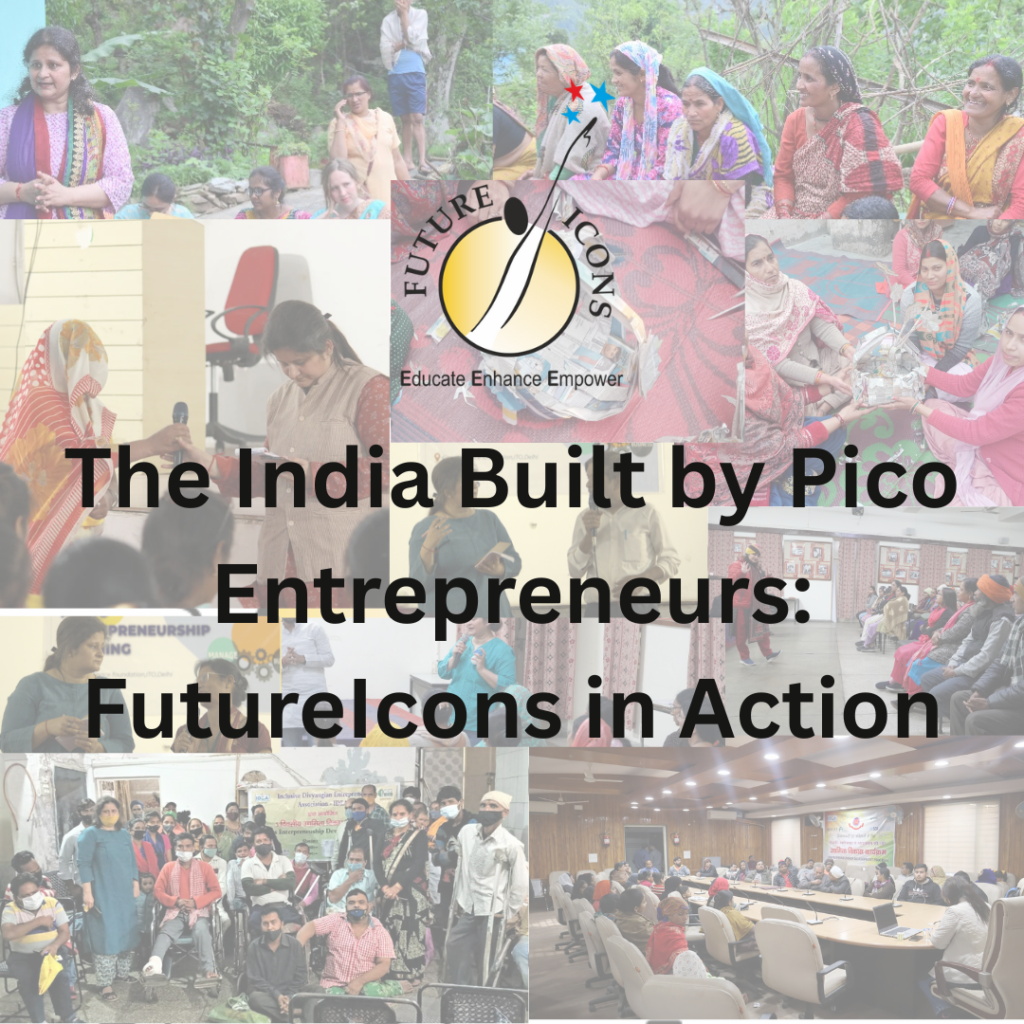
From Svyambhu to FutureIcons: How Self-Reliance Became a Living Movement
Big change rarely begins with big money.
It begins with a simple question: what if people already have what they need, and we just help them see it?
That question sat at the heart of Project Svyambhu, when our founder Dr Akshita Bahuguna first called for self-reliance for all. The early focus was students. But the ground reality spoke louder. Very quickly, the work expanded to women from BPL communities, persons with disabilities, informal workers, and families surviving on daily wages.
That expansion was not strategic planning. It was ethical necessity.
Over the last 10 years, what began as Svyambhu has grown into FutureIcons Foundation, touching lives across multiple states, training 3,000+ individuals, supporting 1,500+ pico entrepreneurs, and indirectly impacting 6,000+ family members. The numbers matter, but the real story sits behind them.
Why Pico Entrepreneurship Had to Be Named
While working on the ground, one truth kept repeating.
People did not need ₹2–5 lakh, pitch decks, or startup jargon.
They needed ₹10,000–₹25,000, skills they already had, and belief.
Traditional labels like micro or nano entrepreneurship failed to capture this reality. That is when Pico Entrepreneurship was born at FutureIcons.
Not as a funding category.
As a philosophy.
Pico entrepreneurship moves people:
-
from charity to choice
-
from dependence to dignity
-
from gig work to genuine ownership
Tiny capital. Massive courage.
FutureIcons as a Training Partner: Education That Translates Into Income
Across every partnership, FutureIcons’ role has been clear and consistent:
we work as a training and capacity-building partner, deeply aligned with our core belief that education must lead to empowerment, not just certification.
Training is not delivered in theory-heavy classrooms. It is rooted in lived language:
How many customers?
What margin is safe?
Which season works?
What can fail, and how do you recover?
This approach came alive powerfully in Delhi, Uttar Pradesh & Uttarakhand.
At India: 2000 Uttarakhand Women and the Power of Skill Visibility
Under the At India initiative, FutureIcons trained 2000 women across Uttarakhand. These women already had skills. What they lacked was direction, confidence, and exposure.
The training focused on:
-
identifying marketable skills
-
basic costing and pricing
-
seasonal demand
-
and simple digital literacy
One woman’s journey became symbolic.
She was skilled at a local craft and worked quietly from home. During training, she was encouraged to document her work. Simple phone videos. Natural light. Honest storytelling. She started posting on social media. Orders followed. First local. Then from outside the state.
Today, she earns not just from her craft, but also from social media visibility. Her phone became her shopfront.
That is education doing its real job.
Chaupal: When Survival Turned Into Ownership
Through Chaupal (Centre for Holistic Advancement and Upliftment of Poor and Landless), Svyambhu met its first real test.
Women who had spent their lives as daily wage workers were suddenly asked to imagine ownership.
Most laughed.
Then they tried.
-
A woman abandoned by her family used a small amount to buy artificial jewellery and sold it house to house. Today, she has steady customers and steady income.
-
Women making wallets now supply to local jewellery shops.
-
Women who sew undergarments work from home with reliable local demand.
-
Some run vegetable stalls, managing daily cash flow independently.
-
Seasonal pico entrepreneurs make Holi colours, Diwali diyas, and Rakhi threads, earning in short, intense cycles.
With Mudra loans of just ₹10,000–₹25,000 and training along with hand-holding, income moved from irregular daily wages to predictable monthly earnings.
These were not success stories crafted for brochures. They were proofs.
IDEA: When Disability Met Entrepreneurship, Not Sympathy
From 2021 onwards, the partnership with IDEA – Inclusive Divyangjan Entrepreneur Association reshaped the scale and depth of impact.
Over 1,000 divyang entrepreneurs associated with IDEA today collectively generate an estimated ₹60 crore in annual turnover.
Some stories stay with you:
-
A mochi who designs shoes inspired by large brands, known locally for quality and finish.
-
A woman who began making threads attached to neckpieces, and later employed others like her.
-
A divyang couple who jointly produce jackets, sharing tasks and decisions.
-
A young boy whose talent for singing found space through jagrans, turning voice into livelihood.
Here, pico entrepreneurship was not optional. It was the only dignified path left. The question shifted from “how disabled are you?” to “how investable is your skill?”
Sewa International: When One Enterprise Builds Many
With Sewa International, pico entrepreneurship gained systems and scale.
-
A divyang man opened a grocery shop and went on to mentor others, becoming a community leader of self-reliance.
-
A woman who designed sarees built a local buyer base and exhibition presence.
-
Another entrepreneur mastered weekly markets, understanding footfall and pricing better than any formal model.
These enterprises may not feature in startup reports. But they show up in school fee receipts, medical bills paid on time, and households that no longer panic at month-end.
The Numbers, Together
Across a decade of work:
-
10+ years of sustained ground engagement
-
35,00+ individuals trained
-
1,500+ pico enterprises supported
-
1,000+ divyang entrepreneurs enabled
-
6,000+ lives impacted indirectly through families and communities
Why Pico Matters in a Unicorn-Obsessed Economy
India celebrates unicorns. And rightly so.
But while startups raised $131 billion, the informal economy quietly sustained 100 million+ self-employed individuals.
A funded startup may create 11 jobs.
A pico entrepreneur sustains an entire household and local supply chain.
If policy only applauds the first, the second is crushed by compliance shock and invisibility.
Svyambhu, Still
FutureIcons may now sound like an institution, but its heartbeat remains Svyambhu.
Self-made.
Self-reliant.
Every sewing machine owned.
Every shop rented independently.
Every woman who moves from wage work to ownership.
Every divyang entrepreneur recognised for skill, not sympathy.
These are not small wins.
These are India’s real IPOs.
And the next decade will not be about counting pico entrepreneurs.
It must be about standing with them, learning from them, and building with them.