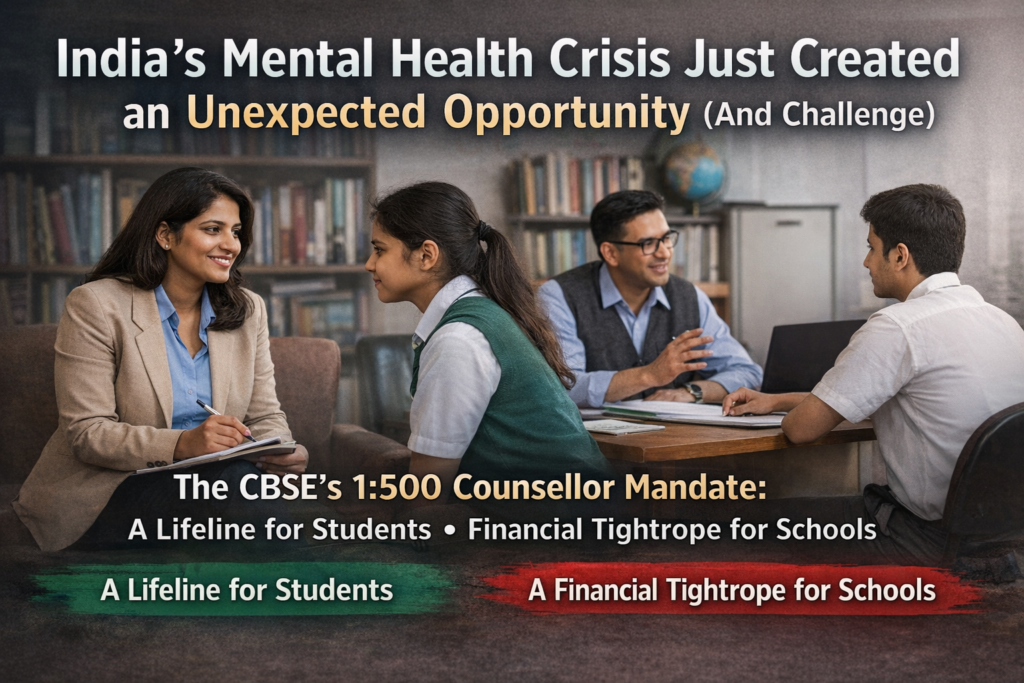
In January 2026, CBSE did something rare. It acknowledged, in writing, that Indian schools are not just academic factories. They are emotional pressure cookers.
The mandate was blunt: Every CBSE-affiliated secondary and senior secondary school must appoint two full-time counsellors. One for socio-emotional wellbeing. One for career guidance. Ratio: 1 counsellor per 500 students. Timeline: next academic session.
No soft rollout. No pilot. No “we’ll see how it goes”.
If you’re a school head, your first reaction probably wasn’t philosophical. It was arithmetic.
If you’re a parent, it was suspicion. And if you work in mental health or education policy, it was long overdue relief mixed with quiet panic.
Because this decision fixes one crisis while exposing three others.
Let’s break it down.
Why CBSE Had No Choice
This mandate wasn’t born in a meeting room. It was born in mortuaries, police records, and NCRB data.
The numbers are uncomfortable, so let’s not soften them.
- 13,800+ student suicides in 2023
- Nearly 82 percent rise since 2011
- Growing at about 4 percent every year
- 864 deaths in 2021 explicitly linked to exam failure
And this is only reported data. Anyone who has worked with adolescents knows how much goes unreported.
Now look at the infrastructure meant to prevent this.
India’s average ratio before this mandate? One counsellor for 5,000 students.
The WHO recommendation is 1:250.
That’s not a gap. That’s abandonment.
So CBSE did the only thing it could within Indian constraints. It chose 1:500. Not ideal, but achievable. A compromise between reality and responsibility.
This is not policy overreach. It’s damage control.
A Crucial Detail Most People Missed
This mandate is not for middle schools.
Only Classes 9 to 12 fall under it.
That’s not an accident.
This is where:
- Board pressure peaks
- Career anxiety explodes
- Identity crises surface
- Self-harm risk rises sharply
Middle schools have a different directive: skill education through NCERT’s Skill Bodh framework. Important, yes. But not therapeutic.
Why this matters: Schools with only Classes 9–12 are directly impacted. Smaller schools get partial relief. And institutions panicking about counselling for Class 6 can breathe, for now.
But don’t be fooled. This exemption won’t last forever.
The Money Question No One Wants to Answer
Let’s stop pretending this is free.
For a mid-sized private school with around 400 students in Classes 9–12, the math looks like this:
- Socio-emotional counsellor: ~₹4 lakh/year
- Career counsellor: ~₹4.5 lakh/year
- Statutory costs and benefits: ~₹1.7 lakh
Total: roughly ₹10–10.5 lakh annually
For a school running on an ₹80–90 lakh budget, this eats up over 10 percent of operating costs.
For a large school with a ₹5 crore budget? Barely a rounding error.
That’s the uncomfortable truth. This mandate is regressive. Smaller schools feel it hardest. And those schools often serve families with the least financial flexibility.
Government Schools: Where the Policy Starts Cracking
On paper, government schools are covered.
In practice, this is where the system starts lying to itself.
The approved salary band for counsellors in many government setups? ₹26,000–31,000 per month.
Here’s the reality: A qualified psychologist or social worker can earn three to four times more elsewhere.
Punjab’s own PM Shri school rollout exposed this. Out of 24 schools, only six could appoint counsellors.
Not because they didn’t want to. Because the talent simply wouldn’t come.
So what happens next?
- High turnover
- Underqualified appointments
- Box-ticking compliance
- And the students who need support the most get the weakest version of it
That’s not reform. That’s theatre.
Unless salaries are revised and central funding steps in, government schools will remain on the wrong side of this mandate.
The Quiet Opportunity No One Is Talking About
While schools panic, another sector should be paying attention.
This mandate could create 40,000 to 60,000 jobs in mental health and career guidance.
Let that sink in.
- Psychology graduates
- Counselling diploma holders
- Social work professionals
- Training institutions
- Supervisors and researchers
This is one of the largest mental health employment triggers India has seen in decades.
If implemented well, it professionalises counselling inside schools instead of treating it as an add-on.
But only if quality is protected. Bad counselling is worse than none.
How Smaller Schools Can Survive This Without Bleeding
Here’s the part most policy documents don’t help with.
If you run a small or standalone school, you don’t need heroics. You need strategy.
Some options that actually work:
Consortium hiring Three nearby schools share counsellors. Everyone complies. Everyone pays less.
Hub-and-spoke models One lead counsellor supports multiple schools using scheduled visits and tele-counselling.
Part-time appointments Allowed for schools with fewer than 300 students in Classes 9–12.
Teacher-to-counsellor pathways Train interested teachers over two years instead of hiring entirely new staff.
Transparent fee communication Parents react better to honesty than hidden hikes. A clear wellness fee is easier to defend than vague increases.
None of these dilute intent. They just respect financial reality.
The Question CBSE Didn’t Ask (But Should Have)
Why start at Class 9?
Because that’s where the damage becomes visible.
But mental health issues don’t begin there. They surface earlier. Quietly. In Class 6. In Class 7. In Class 8.
By the time a child reaches Class 11, you’re often managing fallout, not prevention.
Right now, middle schools sit in a grey zone. Not mandated, but increasingly expected to act.
Prediction: Within five years, counselling will extend downward. Schools that prepare early won’t scramble later.
So Is This a Good Policy?
Yes. Unequivocally.
Is it messy? Also yes. Is it underfunded in government schools? Absolutely. Will it strain small institutions? No doubt.
But here’s what matters.
For the first time, the system has admitted that academic excellence without emotional safety is hollow.
For the first time, a trained adult is officially mandated to listen before a crisis becomes irreversible.
For some students, this won’t just improve grades or career clarity. It will keep them alive.
That alone makes the discomfort worth it.
Now the real work begins. Making sure this mandate doesn’t remain a checkbox, but becomes what it was meant to be: a safety net where none existed before.