
Reverse thinking and reverse calculation — that’s what entrepreneurship has taught me. I often begin from the outcome and walk backwards. Perhaps that’s why dreams feel so familiar to me. They are unfinished thoughts, completing themselves without permission.
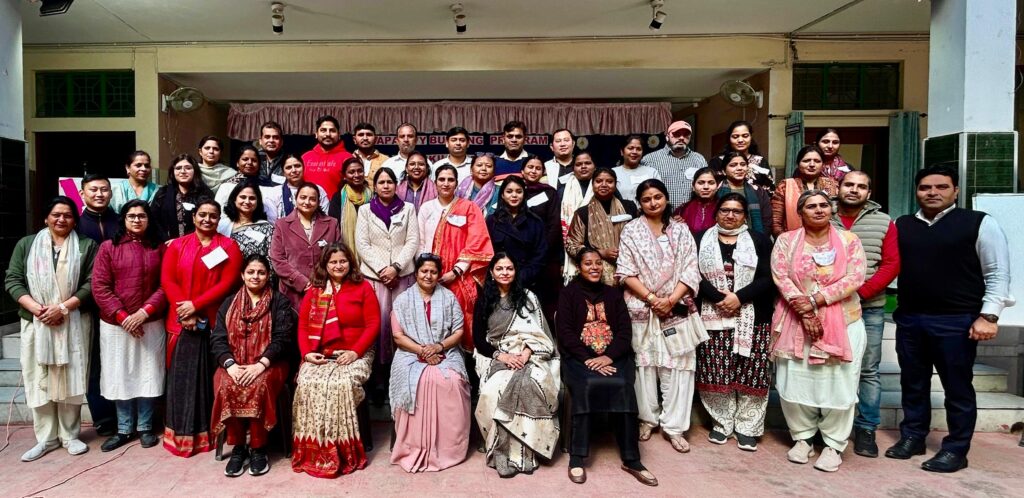
A few weeks ago, I was facilitating a CBP session on life skills with in-service teachers. The room was alive—voices overlapping, experiences spilling out, the familiar warmth of educators who have seen too much yet still show up.
In the middle of that discussion, one teacher paused and asked quietly,
“AI can already write essays, code software, design cities, and even tutor students with infinite patience. Everything we once taught is being automated. So… what is the role of schools now?”
The room fell silent for a second.
I smiled, acknowledged the question, and moved on. The module had to be completed. The time was running out. There were slides left.
But something in me stayed back with that question.
That night, it returned.
In my dream, it was the year 2035.
I stood outside the gates of a school I deeply loved—Stimulus Public School. But the gates were locked. Not recently locked. Abandoned. Rust had settled where children once leaned while waiting for dispersal.
The walls still had faded charts:
“Discipline is the bridge between goals and accomplishment.”
“Work hard in silence.”
But the silence had taken over everything.
The playground—once the loudest place—was still. No running footsteps. No arguments over whose turn it was. No child trying to prove they were faster, stronger, better.
Learning had not stopped. It had simply left the building.
Inside, the staff room was frozen in time. A half-used chalk lay on the table. A red pen uncapped. A noticeboard still read:
“Annual Exams Begin Next Week.”
No one came.
Why would they?
Children were learning through personalised AI pods—adaptive, efficient, always available. They coded before they could cycle. Built digital portfolios instead of writing exams. Universities didn’t ask for marksheets anymore—only proof of skills.
Parents didn’t stand in queues for admissions. They compared subscriptions.
Schools, it seemed, had quietly become irrelevant.
And I stood there, feeling like I had arrived late… to a funeral.
Then, in that emptiness, a question emerged. I couldn’t see who asked it.
But I heard it clearly.
“If machines can do everything… who will teach us how to live?”
Something shifted.
Because I suddenly realised—schools were never meant to compete with machines.
They were meant to do what machines will never be able to do.
Not inform, but form.
Not train minds, but shape humans.
A real school was never about completing a syllabus. It was a rehearsal space for society. It was where a child first learns that someone else may think differently—and still deserves respect. Where losing a game hurts, but teaches resilience. Where sharing a bench with someone unlike you slowly dissolves invisible barriers.
That cannot be automated.
As the dream unfolded, I saw something changing.
Not buildings—but intentions.
Playgrounds became dialogue circles where children spoke about fear, failure, friendship.
Morning assemblies were no longer performances—they became spaces of reflection.
Science labs extended into communities—students solving real local problems, not textbook questions.
Exams disappeared. In their place were questions like:
-
Who did you help this month?
-
What problem did you try to solve?
-
Where did you fail—and what did you learn about yourself?
Report cards looked different. They spoke of empathy, responsibility, courage.
One principal in the dream called it
“the curriculum of contribution.”
Parents didn’t ask, “What marks did my child get?”
They asked, “What kind of person is my child becoming?”
And for the first time, education felt… alive again.
When I woke up, I didn’t feel anxious.
I felt clear.
Schools are not disappearing.
They are shedding a skin that no longer serves them.
Because the future will not belong to those who know the most. Machines will always know more.
It will belong to those who understand, who care, who can sit with another human being and make them feel seen.
And maybe that is where we need to pause—as educators.
In the rush to finish the syllabus, prepare for assessments, integrate technology, align with frameworks…
Are we quietly forgetting the most important question?
Not “What did we teach today?”
But “Who did we help a child become today?”
Because tomorrow’s education will not be about knowing what the machine knows.
It will be about feeling what the machine can never feel.
And perhaps, that is the last lesson only a human can teach.
A really good blog and me back again.