
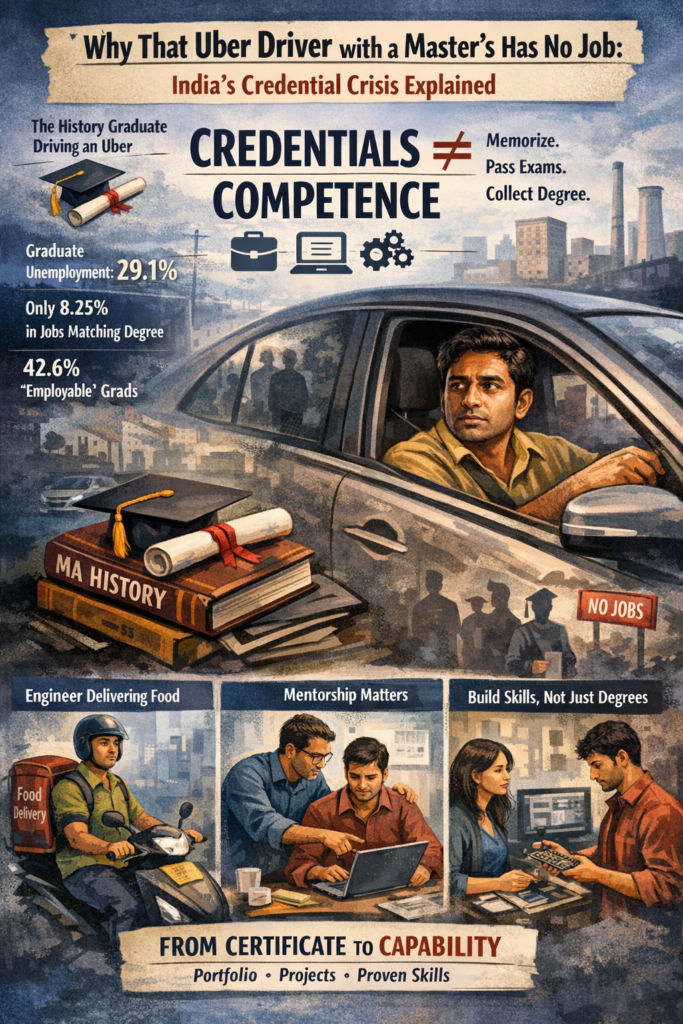
The Anecdote That Changed My Coaching Practice
I’m nervous every time I take an Uber or Ola. In 2021, an accident. A distracted driver. Since then, I talk to every driver to keep them alert, engaged. “What are your working hours? How many hours daily? Do you send your children to school?”
One afternoon, a driver started discussing Indian history—not casually, but analytically. Shuddh Hindi, articulate thoughts, understanding of historical causation and interpretation. When he mentioned his Master’s degree in History, it made horrific sense.
Here was a man, educated and intellectually alive, driving because the labour market had zero use for his knowledge.
That moment crystallized a truth I’d been observing for years as a career coach: Education without competence is just an expensive credential.
In India, unemployment increases with education. Graduate unemployment: 29.1%. Illiterate unemployment: 3.4%.
A person who never attended school has nine times better job prospects than someone with a Master’s degree.
Only 42.6% of Indian graduates are deemed employable by industry standards despite formal qualifications. Worse: only 8.25% work in roles matching their education. An engineer delivers food. A commerce graduate works in retail. A historian drives cars.
This isn’t a job shortage. It’s a competence shortage.
The System Produced Credentials, Not Capability
Our education model is broken at its core: It measures what you memorized, not what you can do.
What employers actually seek:
-
Problem-solving ability
-
Digital fluency
-
Adaptability
-
Communication
-
Learning agility
-
Initiative
What colleges teach:
-
Memorize the syllabus.
-
Pass exams
-
Collect degree
Only 8.6% of institutions report industry alignment. Only 9.4% have mandatory internships. Only 7.56% have industry professionals as regular faculty. Meanwhile, 80% of employers prioritize skills-based hiring over degrees.
The gap between what education produces and what employment demands is a chasm.
Three Hard Truths for Every Student
1. Your degree doesn’t prove competence. It proves compliance.
A degree means you sat in a classroom, memorized content, and passed tests. It doesn’t mean you can think critically, solve novel problems, or create value in a workplace. The history master knew his subject deeply but had zero evidence of capability: no portfolio, no projects, and no demonstrated ability to apply knowledge.
2. The system won’t fix itself in time to help you.
Curriculum changes take 2-3 years to implement. By then, market needs have shifted. Faculty are incentivized for research publications, not graduate employability. Institutional change is glacially slow.
You cannot wait. You must build competence independently.
3. Employers don’t care where you went to college anymore.
80% now hire based on demonstrated skills, not institutional pedigree. They want portfolio evidence: projects you’ve built, problems you’ve solved, outcomes you’ve measured. Not certificates. Capability.
What Competence Actually Looks Like
Not: “I learned Database Design in college.”
Rather: “I built a database system to solve X problem, achieving Y outcome. Here’s the code. Here’s the case study. Here’s what I learned.”
Not: “I have a Marketing degree.”
Rather: “I designed and executed a campaign that increased engagement by 35%. Here’s my strategy document. Here’s the data. Here’s what I’d do differently next time.”
Competence has evidence. It’s demonstrable. It’s contextual. It creates value.
Credentials are just paper.
The Mentorship Multiplier
One intervention works consistently: real mentorship from someone in your target field.
Not career counselling (transactional advice). Real mentorship—sustained relationship with someone who:
-
Understands your specific field
-
Has navigated the challenges you face
-
Holds you accountable to building demonstrated competence
-
Provides network access
-
Guides continuous learning
Research shows this dramatically improves employability, career trajectory, and income progression.
The History Master never had this. No mentor to ask: “How do historians create value? In policy? In museums? In education? In cultural institutions?” No one to guide him toward building a portfolio or accessing relevant networks.
Mentorship translates credentials into careers.
Your Action Plan: Credential → Competence
Month 1-2: Capability Audit
What can you actually do? Document projects, problems solved, things built. Not grades. Evidence.
Month 2-3: Identify Gaps
What capabilities does your target role require that you lack? Get specific.
Month 3-8: Build Competence
Complete real projects. Build a portfolio. Get evidence. Work on actual problems, even volunteer work counts.
Ongoing: Find a Mentor
Someone in your field. Ask them to guide you, review your work, challenge your thinking, introduce you to others.
Ongoing: Create Demonstrable Evidence
Blog posts. GitHub repositories. Case studies. Write-ups of failures and lessons. This is your “prove it” to employers.
When you interview, you’re not competing on credentials. You’re competing on capability.
Why This Matters Right Now
India adds 7-8 million youth to the labor force annually. Our education system produces millions of credentials. Our economy can absorb only a fraction into meaningful work because most lack actual competence.
The result: underemployment, frustration, wasted potential. Young people intellectually capable but economically static.
The fix is not more colleges. It’s not more degrees. It’s competence—built through experiential learning, mentorship, portfolio development, and the recognition that a credential is just the starting point, not the finish line.
The Uber driver with a Master’s in History is a walking indictment of a system that confused education with employability.
Don’t be him. Build competence. Find a mentor. Create evidence. Translate your potential into actual career trajectory.
Because in 2026, your degree is necessary but entirely insufficient. Your competence is everything.