
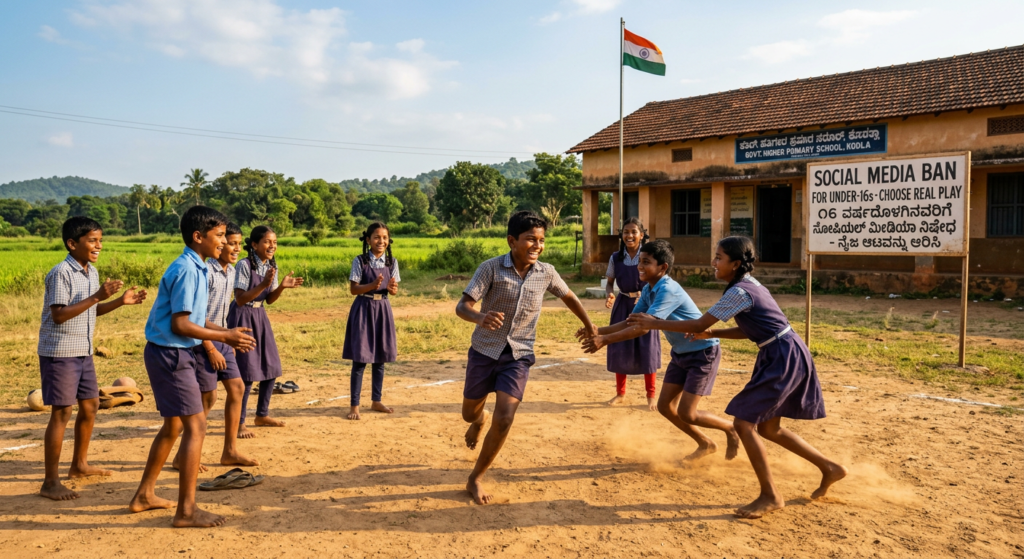
Karnataka bans social media for under-16s. Is this the act of delayed gratification that rescues a generation — or just another policy that sounds brave but blinks at enforcement?
“76% of Karnataka’s 14-16-year-olds spend more time on social media than they do studying. We don’t have a content problem. We have a childhood problem.”
In 1972, a Stanford psychologist sat children in front of a single marshmallow and made them a deal: wait fifteen minutes without eating it, and you’ll get two. What followed was one of the most consequential behavioural studies in history. The children who waited — who exercised that exquisite, painful, profoundly human capacity for delayed gratification — went on to have better grades, better health, stronger relationships and more fulfilling lives. The children who grabbed the marshmallow immediately? Not so much.
Now replace the marshmallow with a smartphone. Replace the fifteen minutes with fifteen years of childhood. And ask yourself: what are we training 472 million Indian children to reach for?
On March 5, 2026, Karnataka Chief Minister Siddaramaiah announced something that made me sit up straight in my chair — a social media ban for all children under 16, paired with ₹565 crore in education investment, 15,000 new teachers, and content labs. Coming from a state that houses Bengaluru — India’s own Silicon Valley — this is not just policy. This is a declaration.
The Marshmallow Test Reimagined
Walter Mischel’s original test measured a child’s ability to resist one immediate reward for a greater future one. Social media has reverse-engineered that test. Every scroll delivers a micro-reward: a like, a comment, a reel that makes you laugh. The algorithm doesn’t offer two marshmallows later — it offers an infinite stream of marshmallows right now. The dopamine loop doesn’t build self-regulation. It destroys it. Karnataka’s ban is India’s first institutional answer to Mischel’s test at scale.
The Numbers Don’t Lie — They Scream
3.2 Hours daily on screens instead of books
54% Teens reporting anxiety & sleep loss
46% Exposed to deepfake content
Karnataka’s 67.6 million people — 25% under 15 — sit inside a national crisis. India has 750 million smartphones. Ninety-five per cent of 16-18-year-olds own one. Eighty-two per cent of parents say platforms offer poor harm redress. Post-COVID, addiction referrals in schools have spiked. Rural-urban gaps are widening. Boys lead usage. And classrooms bear the full brunt of fractured attention — especially for neurodiverse children who need structure, not stimulus overload.
NEP 2020 calls for experiential, multidisciplinary, higher-order thinking. Bloom’s taxonomy demands recall, application, synthesis, and evaluation. How do we build those capacities in children whose neural pathways have been rewired for 6-second gratification? We cannot. Not without intervention.
Thought Experiment #1
What if we did nothing?
Imagine Karnataka classrooms in 2030 where the ban was never implemented. Teachers standing before rooms of children whose attention spans have shrunk to under 90 seconds. NEP 2020’s bold vision of critical thinking and project-based learning turning to dust because no child can sit through a 20-minute activity without reaching for a phantom phone. India’s demographic dividend — the very thing we stake our future on — becoming a demographic deficit, one dopamine hit at a time. That is not dystopia. That is trajectory.
What the World Has Already Learned
Karnataka is not the first. The world has been running this experiment for several years now, and the results are instructive — sometimes inspiring, sometimes cautionary.
Australia Partial Win
The 2025 under-16 ban backed by AUD 50M fines and ID checks showed early results — screen locks rose, teen social media use dropped measurably in compliance-monitored schools. The caveat: VPN evasion is rampant among teenagers who weren’t given digital literacy alongside the ban. The lesson? Fines deter platforms. Education changes children.
China High Compliance
Under-14 restrictions backed by real-name registration and facial recognition achieved among the highest compliance rates globally. Usage dropped dramatically. But China operates within a centralised state apparatus. India must find a democratic hybrid — use Aadhaar, but build in privacy safeguards. Scalable model; must be adapted for a pluralistic democracy.
European Union Mixed
The EU’s GDPR-backed 16+ consent framework forced big tech compliance on paper, but the proliferation of smaller, less-regulated apps meant children simply migrated. The lesson for Karnataka: platform fines (₹10-50 lakh) are necessary but not sufficient. You must regulate the ecosystem, not just the giants.
United States Policy Failure
Florida’s attempt was struck down in courts. Self-reporting age verification failed spectacularly — 70% of children simply lied. No enforcement teeth. The American experiment is a masterclass in what happens when you make policy without infrastructure. Karnataka must not mistake announcement for achievement.
Thought Experiment #2
What if Karnataka becomes India’s model — and the world watches?
- Karnataka’s NEP compliance data shows a 30% improvement in higher-order thinking assessments among 12-15-year-olds. Teen depression indices fall. Reading hours double. Bengaluru’s edtech ecosystem — uniquely positioned — builds AI-powered personalised learning tools that fill the screen-time void with something generative, not addictive. The “Mobile Bidi, Pustaka Hidi” campaign becomes a national slogan. UNESCO cites Karnataka as the first developing-world model of child-first digital governance. It is entirely possible. But only if we go further than the ban.
The Real Elephant in the Room: Our Teachers
Here is the inconvenient truth that no press release will say: a ban without teacher transformation is a wall without a door. We can restrict social media access. But if children walk into classrooms that are less engaging than a TikTok feed, we have solved nothing. The real challenge — the one that deserves as much investment as the ban itself — is rebuilding the classroom as a place of wonder.
What Teachers Need Right Now:
The AI & Tech in Education Workshop Model
Karnataka’s ₹565 crore includes 15,000 new teachers. That’s the supply side. But what about the quality side? I am calling for a mandatory, structured, ongoing workshop framework that doesn’t just train teachers in content — it equips them to compete with the algorithm.
Here’s what a world-class AI & Technology in Education workshop looks like for Karnataka’s teachers:
AI Literacy for Educators
How to use tools like AI and adaptive platforms to personalise learning — so every child gets a differentiated path, not a one-size-fits-all lesson.
Neuroscience of Attention
Understanding dopamine, focus cycles, and why distracted brains aren’t broken — they’re just untrained. Teachers who understand the brain can rebuild its capacities.
Vedic Mindfulness & Box Breathing
Ancient Indian techniques meet modern classroom management. Five minutes of breathwork before a lesson changes attentional bandwidth. This is not soft — this is science.
NEP 2020 Digital Pedagogy
How to design Bloom’s-aligned, project-based assessments that are more compelling than a reel. Engagement through challenge, not notification.
Digital Safety Facilitation
Teachers must become the first line of cyberbullying response. Role-play training, case-study analysis, restorative circle techniques.
Family-School Digital Pacts
Workshops that train teachers to lead parent sessions — building home-school consistency so the ban doesn’t end at the school gate.
Thought Experiment #3
What if every Karnataka teacher received 40 hours of AI-in-education training this year?
Not a one-day seminar. Not a PDF shared on a WhatsApp group. A genuine, hands-on, pedagogically rigorous 40-hour programme. Teachers who understand how AI tools can diagnose learning gaps in real time. Who can use data dashboards to identify the child who is falling behind before they fall out. Who know how to make a history lesson more gripping than Instagram Stories. The ₹565 crore is a start. But the multiplier effect of an upskilled teacher — who reaches 40 children a class, and 4 sections a year, for 20 years — is incalculable. That is your real return on investment, Karnataka.
The Maslow Before the Bloom
We keep talking about higher-order thinking skills. But Abraham Maslow was right before Benjamin Bloom. A child who doesn’t feel safe — who is cyberbullied at 11pm by a classmate, who encounters a deepfake of herself circulated at school, whose self-esteem has been calibrated by like counts — cannot think critically. She is stuck at the base of the pyramid, fighting for psychological safety.
Karnataka’s ban addresses Maslow’s second tier — safety — and creates the prerequisite conditions for Bloom’s taxonomy to function. This is not soft policy. This is foundational architecture. And the research is unambiguous: global parallels from Australia to Finland show teen depression indices fall when social media access is structurally limited, not just morally discouraged.
The Risks We Cannot Ignore
I am a champion of this ban. But I refuse to be a cheerleader who ignores the cracks. There are real risks here, and naming them is not opposition — it is responsibility.
The Aadhaar Privacy Question: Biometric age verification via Aadhaar is the most scalable tool available. It is also a privacy minefield. Karnataka must build in robust data minimisation protocols, third-party auditing, and sunset clauses. Children’s biometric data in the hands of poorly governed platforms is a risk that could outlast the benefits of the ban by decades.
The WhatsApp Grey Area: WhatsApp sits in a different regulatory category. It is a communication tool as much as a social platform. The line between “social media” and “messaging app” is where enforcement will blur — and where children, parents, and platform lawyers will all test the boundary simultaneously.
The Underground Shift: Australia’s VPN data is the warning signal. When access is blocked without support, children don’t stop. They go underground. They access riskier, less-regulated corners of the internet with no parental visibility. This is worse, not better. The ban must be paired with digital resilience education from day one — not as an afterthought.
Rural-Urban Inequality: The monitoring infrastructure required for this ban — Cyber Wing audits, platform compliance checks, school-based enforcement — is Bengaluru-ready. Is Bidar ready? Is Raichur? The implementation gap between urban and rural Karnataka could mean the ban protects affluent children while rural children face unmonitored access. Equity in enforcement is not a luxury — it is the moral core of the policy.
Thought Experiment #4
What if we gave children something better to reach for?
The greatest mistake we can make is thinking this is a subtraction story — take away the phone, leave a void. The most successful implementations globally — Finland’s screen-free early childhood programmes, Japan’s outdoor-immersive school models, Singapore’s structured digital citizenship curriculum — all understood one thing: you don’t defeat the marshmallow by removing it. You defeat it by making the waiting so interesting that the child forgets it was ever there. What if Karnataka’s ₹565 crore built content labs where children produce — not consume? Where they code, create, debate, perform, build, garden, cook, and lead? Where the classroom becomes the most compelling room in a child’s day?
“The ban is the marshmallow on the table.
What Karnataka does next is the test.”
Sixteen million children are watching. Their teachers are watching. Parents, platforms, and policymakers across India are watching. Karnataka has made the brave call to say: childhood is worth protecting, even from the tools we built. That deserves not just applause — it deserves our full effort to make it work. Enforce it like Australia. Scale it like China. Educate like Finland. And trust our teachers enough to train them for the world they are being asked to navigate. The real triumphs of this generation will not be posted. They will be lived.