

A Research-Backed Analysis of Why the Teaching Profession Deserves Better Than Ideals
The Question That Unsettled the Room: A B.Ed Classroom
During a recent panel discussion on employability and professional readiness at a B.Ed institution, a fourth-semester B.Ed student posed a question that momentarily unsettled the room—but deeply resonated with many:
“Why are teachers not paid well—especially contract teachers and those in public schools whose payments are delayed or merged? A teacher prepares generations for every profession, yet struggles to make ends meet. Then what?”
The student’s question carried an implicit weight that many in that classroom felt acutely. Some of her classmates might enter the same engineering companies that hire their more fortunate peers—the ones who had chosen B.Tech at IIT, NIT, or similar institutions. Those peers would walk into offices earning ₹18–37.5 LPA on average from top IITs, or ₹8–11 LPA from NITs, with clear pathways to doubling that in five years. Meanwhile, the B.Ed student in front of them would likely earn ₹3.6–6 LPA if they secured a government school position—or face the grim reality of private school teaching at ₹1.8–3 LPA.
The principal’s response was familiar, almost rehearsed:
“You invest time, do all the work at a lower salary, gain experience, and then ask for increment.”
But this time, the response did not inspire. It demotivated.
The Institutional Reality: When Institutions Fail to Inspire, They Demotivate
This panel discussion revealed a critical failure not of individual teachers or principals, but of the system’s inability to position teaching as a professional choice, rather than a backup option.
For B.Ed fourth-semester students at that institution—and thousands like them across India—the choice before them is stark and unforgiving. They are entering a profession where:
Comparable-tier B.Tech graduates are earning significantly more:
-
IIT B.Tech graduates: ₹18–37.5 LPA average
-
NIT graduates: ₹8–11 LPA average
-
BITS/IIIT graduates: ₹6–10 LPA
-
Tier-2 B.Tech graduates: ₹3–6 LPA
While B.Ed graduates face:
-
Government school starting: ₹3.6–6 LPA
-
Private school starting: ₹1.8–3 LPA
-
Even “premium” schools average ₹3.3–3.9 LPA
The most damning fact: Even a Tier-2 college B.Tech graduate earns more than a B.Ed graduate from a government school—and far, far more than a private school teacher. There is no institutional prestige, no competitive advantage, no market signal that teaching is a valued profession. There is only a choice between poverty in the private sector or mere adequacy in the government sector.
This is not inspiration. This is institutional demotivation.
The Stark Reality: Not All Colleges Get IIT Placements
The panel discussion takes on added significance when we recognize that most colleges do not deliver IIT-style packages. The data makes this painfully clear:
-
Only 23 IITs and ~31 NITs exist in India. They graduate fewer than 100,000 engineers per year.
-
Over 2,000 engineering colleges exist. Most deliver ₹3–6 LPA packages.
-
Over 2,000 teacher training colleges exist. Most deliver ₹1.8–3 LPA packages.
So the comparison is not just IIT vs. Government Teacher. It is:
| Scenario | B.Tech Starting | B.Ed Starting | Gap |
|---|---|---|---|
| Tier-2 College Graduate | ₹3–6 LPA | ₹1.8–3 LPA | 1.5–3x lower |
| Government School Teacher | — | ₹3.6–6 LPA | Marginally better |
| Private School Teacher | — | ₹1.8–3 LPA | Same as Tier-2 B.Tech |
| Premium Private School | — | ₹3.6–6 LPA | At parity (but no growth) |
Even when comparing like-for-like institutions, teaching does not win. At parity, it merely holds its own. And crucially, there is not a single institution in India where school teachers earn at parity with IIT engineers. Not Delhi Public School (average ₹20.7 LPA, but seniors only). Not Shri Ram Global School (₹3.3 LPA average). Not even premium South Delhi schools, where experienced teachers earn ₹0.75–1.5 LPA while colleagues in tech earn ₹8–12 LPA.
The question for the B.Ed 4th semester student becomes: Why would I choose teaching when a peer from a Tier-2 engineering college will earn more, have faster growth, and enter a profession that India’s economy has explicitly valued?
The Conditioning of School Leadership: A Systemic Trap
Over the years, principals and school leaders themselves have been shaped by a narrative that glorifies teaching as service, impact, nation-building, and dignified sacrifice. These are not false ideas—but they have been weaponized to compensate for the absence of fair compensation.
As a result, many leaders unintentionally internalize and reproduce a belief system where:
-
Passion replaces pay: Teachers are valued for their love of the work, not the market value of their labor
-
Commitment replaces contracts: Dedication is expected regardless of job security or clarity
-
Dedication replaces dignity of remuneration: Extra effort is normalized without corresponding economic recognition
-
Teachers are encouraged to “adjust,” “manage,” and “wait”—often indefinitely
This conditioning is not always intentional. It is systemic. When budgets are tight, policies rigid, and accountability one-sided, motivation becomes emotional rather than structural.
The global research confirms this pattern. Studies on teacher professional development across 35 countries reveal that authentic leadership—characterized by transparency, clear communication, and involvement in decision-making—directly correlates with teacher motivation and performance. Yet when leaders default to moral appeals instead of structural assurance, they are essentially asking teachers to motivate themselves emotionally while the system fails them structurally.
The Dangerous Narrative: “Do More, Earn Later”
The idea that teachers should work more first and earn later assumes several things that, for many educators—and increasingly, for B.Ed students considering this path—simply don’t hold true:
-
That teachers have financial safety nets: In India, contract teachers and those in unaided institutions operate with no safety nets. A commerce lecturer in Bihar described earning ₹9,000 one year, ₹21,000 another, and nothing for four consecutive years. Meanwhile, a colleague suffered and died from untreated cirrhosis due to financial stress.
-
That experience automatically leads to better pay: Research contradicts this. In Indonesia, a rigorous study found that doubling teacher salaries improved job satisfaction and reduced financial stress but had no effect on student test scores or teacher attendance. The challenge is not effort; it’s that the pathway from experience to compensation is often broken or invisible.
-
That patience is professionally sustainable: The evidence says otherwise. A 2024 meta-analysis found that 75% of burnout cases globally stem from high workload and insufficient social support. In India, 80% of teachers report heavy workloads, and only 30% of schools offer dedicated counseling services.
Telling a B.Ed 4th semester student to “gain experience first” when their engineering peer is already earning ₹3–6 LPA with 25% annual growth trajectories is not motivation—it is postponement with psychological harm and concrete economic loss.
The Indian Contract Teacher Crisis: The Visible Cautionary Tale
The situation in India illustrates this perfectly. Contract teachers and guest teachers have borne the brunt of systemic neglect:
-
Uttar Pradesh’s Siksha Mitras were briefly regularized in 2015, only to be demoted two years later—their salaries plummeting from ₹50,000 to ₹10,000 monthly.
-
In colleges across Bihar and Gujarat, lecturers survive on irregular stipends as low as ₹1,500 per month.
-
Salary payments are routinely delayed by 2+ months, forcing teachers to manage household expenses and medical emergencies without income.
As economist Karthik Muralidharan has documented, this creates a fiscal drain of over $1.5 billion annually from teacher absenteeism alone—yet the solution isn’t framed as structural reform but as teacher accountability.
The B.Tech Salary Advantage: A Systemic Signal of What India Values
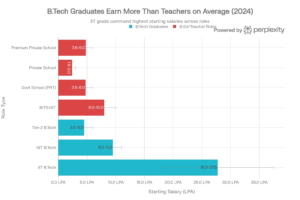
The chart above illustrates a brutal truth. When a B.Ed student looks at their engineering peer’s offer letter, they are not just seeing a higher number. They are seeing a systemic signal: India’s institutions, economy, and policy have explicitly decided that engineering is more valuable than teaching. This is not a hidden belief. It is visible in every job fair, every parent conversation, and every institutional investment.
A B.Tech graduate from a Tier-2 college will likely earn ₹3–6 LPA—squarely in the range of a government school teacher. But here’s the difference:
Trajectory:
-
B.Tech: 25% annual hike trajectory, reaching ₹20–25 LPA in 5 years
-
Government Teacher: 3–5% annual increment (often stalled), reaching ₹6–9 LPA in 5 years
Stability:
-
B.Tech: Multiple companies competing for talent, clear skills transferability
-
Teacher: Frozen by policy, locked into state rules, no negotiating power
Respect:
-
B.Tech: Entry into high-performing sectors, professional autonomy, decision-making authority
-
Teacher: Reduced autonomy, increasing accountability without authority, moral appeals replacing compensation
Growth Pathway:
-
B.Tech: MBA, lateral shifts, startup opportunities, clear progression
-
Teacher: M.Ed, which requires additional sacrifice, offers only ₹8–12 LPA after years of study
No wonder the B.Ed 4th semester student in that institution felt demotivated.
Impact and Income: A False Binary That Harms Everyone
One of the most problematic assumptions in education is that impact and income cannot coexist. This false binary harms both teachers and students.
When teachers are financially stressed:
-
Creativity reduces dramatically
-
Risk-taking in pedagogy declines
-
Burnout increases exponentially
-
Long-term commitment weakens
-
Mental health deteriorates
Ironically, the very “impact” schools speak about becomes harder to sustain. Current global data underscores this: 52–84% of teachers globally report burnout, with the highest rates in the UK (84%) and India (80% workload stress). The problem is not that teachers lack passion. It is that passion cannot substitute for security, respect, and fair compensation.
Contrary to popular belief, the relationship between compensation and performance is nuanced but significant. A comprehensive analysis of 33 teacher professional development programs across low- and middle-income countries revealed that programs linking participation to career incentives—such as promotion or salary increases—showed 0.12 standard deviations higher student learning gains.
The key characteristics of effective teacher development programs are:
-
Link participation to career incentives (promotion, salary advancement)
-
Subject-specific focus rather than generic training
-
Active lesson enactment (practicing teaching during training)
-
Long-term, collaborative engagement with peers
-
Follow-up mentoring visits after training
-
Authentic leadership with transparent communication
Notably, programs that failed to link professional development to tangible career outcomes showed significantly lower effectiveness.
Respect for a Profession Is Reflected in Compensation
We often say teaching is a “noble profession.” But nobility does not negate the need for economic respect.
No other profession is routinely asked to:
-
Work beyond contracted hours without additional compensation
-
Perform administrative, emotional, and community roles simultaneously
-
Continuously upskill without funding or time
-
Be role models, mentors, counselors, and innovators
-
Justify their need for fair pay as evidence of commitment
True respect for the teaching profession is structural, not symbolic. It begins with compensation that reflects the complexity of the work.
The Global Disparity: A Perspective
Luxembourg’s teachers earn $71,647 starting salary, with peak compensation reaching $126,576. Germany begins at $70,419. Even the USA averages $44,992 starting salary. Yet in India, government teachers begin at approximately $9,360 annually in base salary—less than 13% of Luxembourg’s starting compensation.
This is not simply about numbers. This reflects a fundamental difference in how societies value teachers. In countries with higher teacher compensation, there is also:
-
Clearer career progression: Salary scales are transparent and time-bound
-
Better retention: Teachers stay longer in the profession
-
Stronger professional autonomy: Teachers have greater input into curriculum and pedagogy
-
Lower burnout: Even with challenges, basic financial security buffers stress
Meanwhile, India signals to its B.Ed students: You can choose to be a teacher, or you can choose to have a sustainable income. The system does not believe you can have both.
Why Leadership Communication Matters: The Transparency Gap
School leaders play a crucial role—not just as administrators, but as culture-setters and architects of what teachers believe is possible for themselves professionally.
Research on school leadership in Malaysia’s Excellence Cluster Schools found that principals’ authentic leadership practices significantly enhanced teacher motivation. Authentic leadership involves:
-
Self-awareness about one’s own biases and limitations
-
Relational transparency in communication
-
Balanced information processing (considering multiple perspectives)
-
Internalized moral perspective grounded in values, not just compliance
Importantly, a study of compensation reform at Collegiate Academies in New Orleans revealed that when schools introduced transparent, clear compensation structures:
-
Understanding of pay criteria jumped from 41% to 60% of teachers
-
Perception of fair compensation rose from 40% to 52%
-
Teacher retention improved significantly
The lesson is simple: transparency about compensation—even imperfect compensation—is far more motivating than secrecy combined with moral appeals. A B.Ed student considering teaching needs to hear: “Here is what you will earn. Here is when you can expect raises. Here is what the career trajectory looks like.” Instead, what they hear is: “If you love it enough, it will be worth it.”
What Should Change in Leadership Conversations?
The shift must be deliberate and systemic. School leaders and principals must move from:
| Current Approach | Needed Approach |
|---|---|
| “Adjust now, grow later” | “Grow with clarity and timelines” |
| Moral motivation (“teaching is service”) | Professional assurance (“teaching is respected work”) |
| Silence on pay | Advocacy for fair structures |
| Hidden compensation decisions | Transparent progression frameworks |
| One-time training | Continuous, collaborative development |
| Individual responsibility for motivation | Systemic support for wellbeing |
Even when budgets are constrained, honesty and transparency matter profoundly. What leaders can do immediately:
-
Clarify progression frameworks: Define exactly what skills, experience, or credentials lead to advancement—and when.
-
Communicate timelines: Be honest about when increments, promotions, or transitions might occur.
-
Recognize additional responsibilities: Formalize and compensate roles beyond classroom teaching.
-
Advocate upward: Use data to make the case for better budgets and fairer compensation.
-
Create space for voice: Involve teachers in decision-making about their own development.
-
Address burnout structurally: Reduce workload, increase planning time, provide mental health support.
For B.Ed students specifically, institutions must:
-
Communicate honestly about job market realities: Tell them the salary ranges, the growth trajectories, and yes, the gaps versus B.Tech.
-
Build institutional pathways to higher-paying roles: Special schools, international schools, educational leadership roles that do offer better compensation.
-
Create partnerships with premium schools: Where B.Ed graduates can intern and potentially secure higher-paying positions.
-
Emphasize the unique value of teaching: Not as backup option, but as deliberate choice—with clarity about what that choice costs.
The Missing Piece: Systemic Accountability
India’s education system faces a unique accountability challenge. As economist Karthik Muralidharan has noted, there is a “concentration of costs and diffuse benefits” problem in education reform.
When a teacher improves—and all their students benefit—the benefit is distributed across hundreds of families and ultimately, society. But the cost of holding schools accountable falls on teachers. Meanwhile, the decision-making is centralized, often far from schools.
This creates a perverse incentive structure:
-
Panchayats cannot hold teachers accountable (no spending power)
-
Teachers cannot access local support (decisions made in state capitals)
-
Families know about poor teaching but are powerless (no recourse mechanism)
-
Politicians hesitate to reform (strong unions + concentrated teacher resistance)
The exception proves the rule: Telangana’s performance-based contract system for junior panchayat secretaries resulted in:
-
Only 5% of panchayats nationally, but 40% of national Panchayati Raj awards
-
Eight out of nine award categories won
-
Success attributed to clear 3-year contracts with regularization tied to performance
This is not about firing teachers. It is about creating accountability systems where everyone benefits when teachers succeed.
Reframing the Message to Teachers (and B.Ed Students)
The profession needs a different narrative. Perhaps it is time to stop saying:
“Teaching is service, so sacrifice is expected.”
And start saying:
“Teaching is a profession. Professionals deserve growth, respect, security, and fair compensation.”
This is not less noble. It is more honest.
For B.Ed students entering the profession, the message should be:
“Teaching offers genuine impact, intellectual engagement, and the privilege of shaping lives. It also offers professional respect through fair compensation, clear career progression, and institutional support. You are not choosing between ideals and income. You are choosing a profession that deserves both.”
A Closing Reflection: The Societal Cost of Silence
The student’s question at that B.Ed institution was not just about salary. It was about fairness, dignity, and the future of the profession.
The stakes are high. Global projections indicate that over 270,000 teachers in the USA alone will leave the profession annually for the next three years. In India, teacher shortages persist despite salary improvements, suggesting that issues beyond compensation—job security, dignity, recognition, and competitive positioning against other professions—are driving attrition.
If we continue to motivate teachers (and prospective teachers) only through ideals—without investing in their professional growth and economic security—we risk:
-
Losing the most committed educators to burnout or exit
-
Concentrating our best teachers in wealthier schools where retention is easier
-
Deepening educational inequality
-
Failing future generations
-
Most immediately: Demotivating B.Ed 4th semester students from choosing teaching at all
When teachers leave, the loss is not personal. It is societal. When B.Ed students choose not to enter teaching, we lose generations of potential educators before they even begin.
A Final Word: Respecting Teachers Begins with Systems
Respecting teachers begins when we stop asking them to survive on ideals—and start building systems where impact and livelihood grow together.
This means:
-
Transparent, time-bound career progression that teachers (and prospective teachers) can understand and plan for
-
Compensation aligned with professional respect, not determined by how little teachers are willing to accept
-
Mental health support as a non-negotiable institutional investment
-
Authentic leadership that communicates clearly and involves teachers in decisions
-
Systemic accountability that empowers rather than burdens teachers
-
Honest institutional messaging about the trade-offs and real earnings potential
These are not luxuries. They are the minimum requirements for a profession that we ask to shape the future.
Teaching is noble work. But nobility deserves infrastructure, not just ideals.
For that B.Ed 4th semester student—and thousands like her—the question is simple: Will India’s institutions respect teaching enough to compete with engineering for the best minds? Or will the answer remain: “Adjust, manage, and wait”?
This reflection is offered to every principal, every teacher, every B.Ed student, and every policymaker working to transform education. The student who asked the original question was not challenging the profession. They were asking for it to be honored—truly honored, not just rhetorically. That honoring begins now.