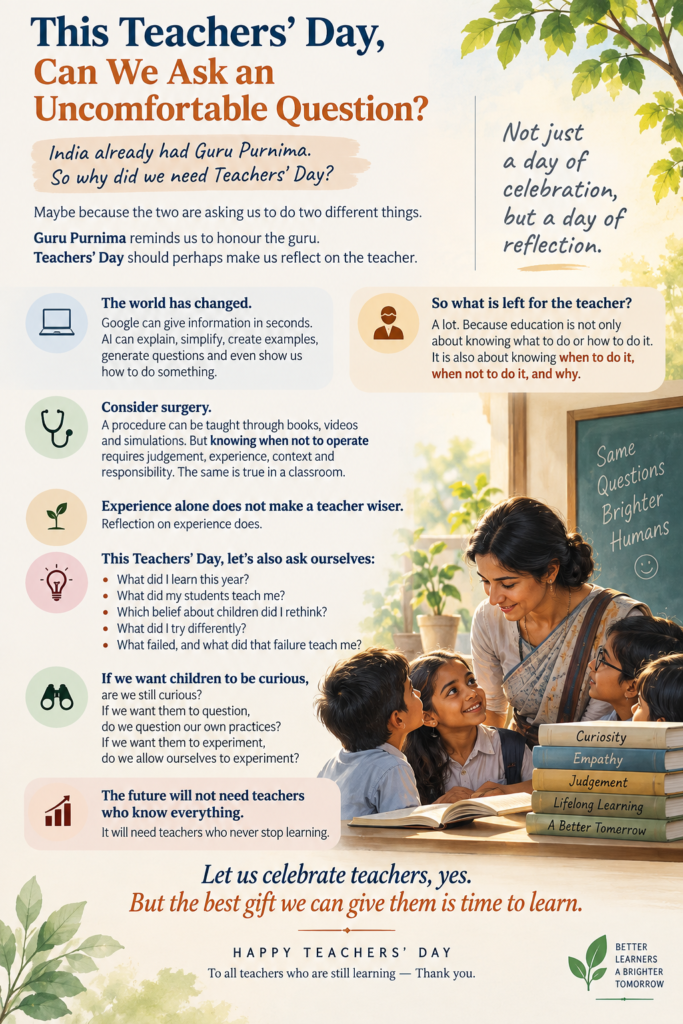
India already had Guru Purnima.
So why did we need Teachers’ Day?
Maybe because the two are asking us to do two different things.
Guru Purnima reminds us to honour the guru.
Teachers’ Day should perhaps make us reflect on the teacher.
And that reflection is more important today than ever.
Once, the teacher was the person who had the knowledge.
Today, Google can give information in seconds.
AI can explain, translate, simplify, create examples, generate questions and even show us how to do something.
So what is left for the teacher?
A lot.
Because education is not only about knowing what to do or how to do it.
It is also about knowing:
When should I do it?
When should I not do it?
Why does it matter?
What could go wrong?
A surgical procedure can be taught through books, videos, simulations and technology.
But knowing when not to operate requires something more: judgement, experience, context and responsibility.
The same is true in a classroom.
A teaching strategy that works beautifully for one child may fail completely for another.
The teacher’s real expertise lies in recognising the difference.
But there is a catch.
Experience alone does not make a teacher wiser.
Reflection on experience does.
So perhaps this Teachers’ Day, along with the celebrations, every teacher could ask themselves:
What did I learn this year?
What did my students teach me?
Which belief about children did I rethink?
What did I try differently?
What failed?
What did that failure teach me?
Because here is the uncomfortable truth:
We cannot build lifelong learners if the adults in the learning system have stopped learning.
If we want children to be curious, are we still curious?
If we want them to question, do we question our own practices?
If we want them to experiment, do we allow ourselves to experiment?
And if AI is increasingly taking over the job of delivering information, perhaps this is not a threat to teachers.
Perhaps it is an invitation.
An invitation to move from being the provider of answers to being the builder of judgement.
From “Here is what you need to know” to
“Let’s think about what this means.”
From “This is the right answer” to
“How do you know?”
From teaching students what to think to helping them learn how to think, when to act and when to pause.
So, yes, let us celebrate teachers this 5 September.
But perhaps the best gift we can give them is not another speech about how great teachers are.
Give them time to learn.
Time to read.
Time to experiment.
Time to observe.
Time to discuss.
Time to reflect.
Because the future will not need teachers who know everything.
It will need teachers who never stop learning.
And perhaps that is the real meaning of being a guru in the age of Google and AI:
Not to have all the answers,
but to help a learner develop the wisdom to know which questions to ask, which choices to make, and when not to act.