Years ago, during my PhD, I got stuck with an academic problem that refused to go away. The problem itself was bad enough. What hurt more was the feeling that nobody wanted to listen.
But there was one teacher who gave me hope. She was articulate, confident, and famously outspoken. The kind of person who said in meetings what everyone else only whispered in corridors. So I gathered my courage and knocked on her door.
She listened to me for almost an hour. She nodded. She agreed. She even criticized the system with more fire than I had. Then she said the words I had been waiting weeks to hear:
“Let’s go together. I’ll present your case before the Dean.”
I floated out of her office. Finally, someone was on my side.
Then we entered the Dean’s office.

And something strange happened. Before I could speak, before she could raise a single point we had discussed, the confident academic I had met an hour ago simply… vanished. In her place stood a different person. Someone who defended the very system she had torn apart minutes earlier. My concerns were never voiced. My case was never presented.
I walked out confused. Had I imagined that entire hour in her office?
It took me years to understand what I had actually seen that day.
It wasn’t hypocrisy.
It was fear.
Accountability Is Essential. Fear Is Not.
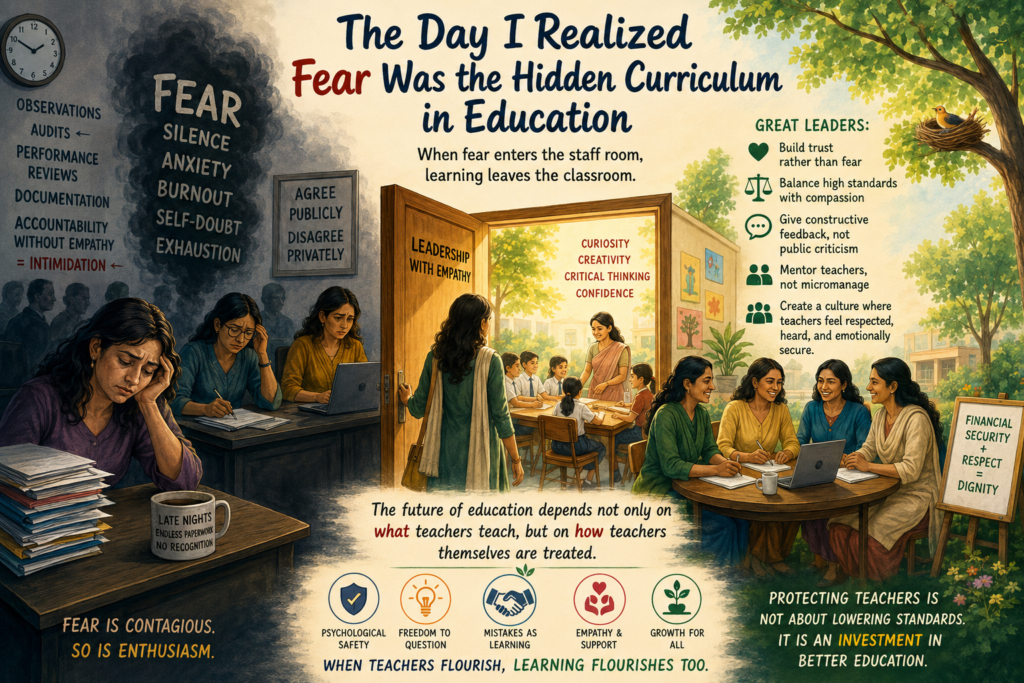
Schools and universities love the language of accountability. Observations, performance reviews, documentation, audits, quality assurance, continuous improvement. Nothing wrong with any of it. Every profession needs accountability.
But somewhere along the way, accountability quietly changes its costume and becomes intimidation.
The missing ingredient is empathy.
When accountability exists without empathy, it stops improving people and starts controlling them.
That day during my PhD, I did not witness a weak teacher. I witnessed a strong teacher trapped inside a culture that punished courage. Fear had become institutional. It wasn’t in her. It was in the walls.
I See the Same Pattern in Every School
For the past several years, I have conducted Competency-Based Education Programmes across schools in different parts of India. And the first few hours of every workshop follow a script I could now write in my sleep.
Teachers hesitate before speaking. They glance around the room before disagreeing with anything. Even when I beg for honest opinions, many begin with, “I don’t know if I should say this…”
I once asked a room of nearly sixty teachers, “Raise your hand if you have disagreed with your principal in the last year.” Nobody moved. I changed the question. “Raise your hand if you have privately disagreed.” Every face smiled.
Think about that for a moment. These are people whose full-time job is building confident learners. And they are nervous about sharing an opinion in front of colleagues.
Here is what most people get wrong: they assume children imitate what teachers say. In reality, children imitate what teachers feel.
Fear is contagious. So is enthusiasm. A fearful teacher unconsciously creates cautious learners. A curious teacher creates curious learners. Children are excellent at catching things we never intended to teach.
You Cannot Teach Curiosity If You Cannot Practice It
Every education policy today speaks about critical thinking, creativity, innovation, and inquiry. Beautiful words. But there is an uncomfortable question hiding underneath, and we rarely ask it:
Can teachers cultivate curiosity if they themselves are discouraged from questioning?
Fear does something remarkable to the human brain. It narrows attention. Survival replaces exploration. We stop asking “What if?” and start asking “What is safe?” When this becomes the emotional climate for teachers, expecting classrooms full of curiosity becomes wishful thinking. Creativity cannot grow where psychological survival has become the first priority.
A teacher who constantly fears making mistakes eventually stops experimenting. A teacher who fears criticism stops innovating. A teacher who fears authority slowly becomes a follower instead of a thinker.
And students learn far more from what teachers model than from what textbooks prescribe. Curiosity cannot survive in a place where compliance earns more rewards than a thoughtful question.
The Forgotten Wisdom of Vāda, Jalpa, and Vitaṇḍā
Ancient Indian knowledge traditions understood something our modern institutions have forgotten: not every argument serves the same purpose.
Vāda is dialogue in pursuit of truth. Both sides listen, reason, and stay open to changing their minds.
Jalpa is debate to win. The goal quietly shifts from finding truth to defeating the opponent.
Vitaṇḍā goes one step further. It is not about presenting better ideas at all. It is about attacking, dismissing, or discrediting the other person.
Every staff meeting should aspire to Vāda, where truth matters more than hierarchy. Too often they become Jalpa, where people defend positions instead of ideas. And in the worst cases, they descend into Vitaṇḍā, where questioning a proposal becomes questioning the person. Once that happens, silence replaces dialogue.
Teachers begin agreeing publicly and disagreeing privately. Over time, this erodes trust, weakens collaboration, and leaves institutions poorer in ideas.
When questioning is discouraged, genuine dialogue disappears. And institutions lose one of their greatest strengths: collective wisdom.
Burnout Is Not a Badge of Honour
Another dangerous story has quietly entered education: the best teachers are those who sacrifice everything.
Late nights. Endless paperwork. Weekend meetings. Constant availability. Emotional labour with no recognition. Somehow, this has become the uniform of commitment.
It shouldn’t be.
Exhaustion is not excellence. Burnout is not dedication.
A tired teacher can still complete lesson plans. But inspiration requires energy. Creativity requires emotional space. Compassion requires psychological reserves. You cannot pour from an empty cup — and we keep asking teachers to pour from cups we never refill.
Leadership Defines the Emotional Climate
Every school has policies. But policies do not shape culture. Leaders do.
I have worked with institutions where teachers eagerly share half-formed ideas because they know mistakes are treated as chances to learn. I have also worked with institutions where a single classroom observation creates weeks of anxiety, as if an inspector were arriving with a search warrant.
Same policies. Different leaders. Completely different worlds.
Educational leaders are not merely administrators. They are custodians of emotional climate. And strong leadership does not lower standards — it raises them while preserving dignity.
Great leaders build trust before demanding performance. They balance accountability with compassion. They give constructive feedback instead of public criticism. They mentor instead of micromanaging. They listen before judging. They create spaces where teachers feel psychologically safe.
Here is something we rarely admit: empathy is not simply kindness. Empathy is courage. It takes courage to listen to disagreement. It takes courage to allow teachers to fail. It takes courage to hear criticism without feeling threatened. A fearful leader creates fearful teachers. A courageous leader creates courageous teachers.
So here is my challenge to every school leader reading this. If every teacher in your school agrees with you, don’t celebrate. Ask yourself whether they agree because you are right, or because they are afraid.
People grow where they feel respected. It really is that simple, and that rare.
Schools Are Not Assembly Lines
Education has borrowed too many ideas from industrial management. Targets, outputs, efficiency, compliance, metrics. These have their place.
But schools are not factories producing identical products. Every classroom is a living ecosystem. Every child is different. Every teacher brings a unique personality, style, and emotional presence.
Relationships cannot be standardized. Inspiration cannot be manufactured. Learning cannot be reduced to a spreadsheet, no matter how colourful the cells are.
When institutions start behaving like assembly lines, teachers and students slowly lose the very thing that makes education human.
The Conversation We Keep Avoiding: Money
There is one more reality we politely step around.
Teachers are expected to nurture future generations while many of them quietly struggle with financial insecurity.
Yes, respect matters. Recognition matters. Professional autonomy matters. But dignity also has an economic dimension. A teacher who is constantly worried about paying bills or securing their family’s future carries an invisible cognitive burden into every classroom.
And here is the uncomfortable part: many school leaders have become masters at motivating teachers through emotions and responsibility — “do it for the children” — while staying completely silent on financial security and dignity.
Financial security does not automatically produce great teachers. But chronic financial stress certainly makes excellent teaching harder. Supporting teachers means supporting both their emotional and their economic wellbeing.
We often tell teachers that education is a noble profession. Nobility, however, should never become an excuse for economic neglect. A profession entrusted with shaping the future cannot continue expecting sacrifice while offering insecurity.
The Hidden Curriculum
People often ask me what the biggest challenge in education is. Technology? Artificial intelligence? Curriculum reform? Assessment?
I think the answer is much quieter.
It is the emotional culture in which teachers work.
Students do not simply learn mathematics, science, or history. They also absorb confidence, curiosity, empathy, courage, and resilience from the adults who teach them.
If teachers feel trusted, students learn trust. If teachers experience respect, students learn respect. If teachers feel safe to ask questions, students become fearless learners.
But when fear enters the staff room, it silently walks into the classroom too. Nobody announces it. Nobody puts it on the timetable. Yet every child learns it perfectly.
That teacher outside the Dean’s office all those years ago taught me more than any course in my PhD. Not about the subject. About the system.
The future of education will depend not only on what teachers teach, but on how teachers themselves are treated.
Protecting teachers is not about lowering standards. It is about creating the conditions in which excellence can truly flourish.
Because when teachers flourish, learning flourishes too.