
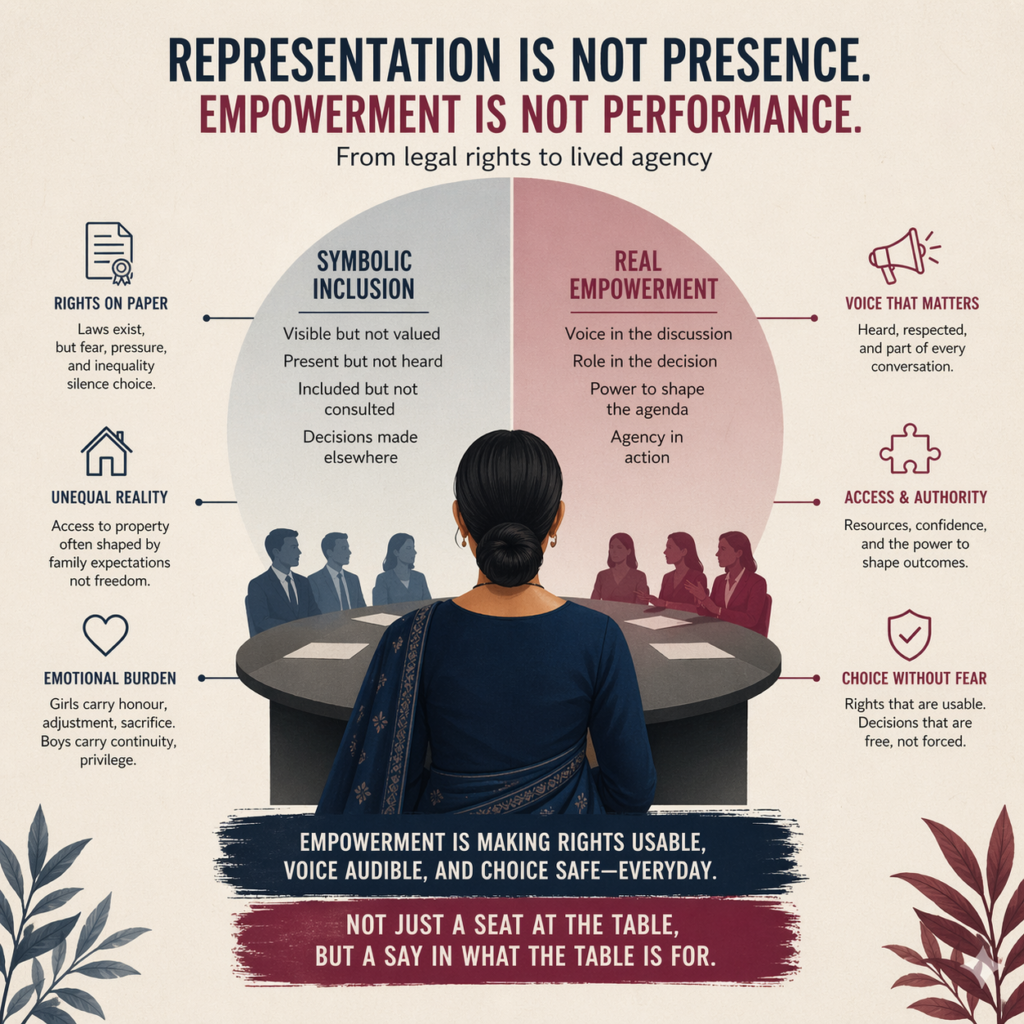
We’ve become comfortable with the optics of empowerment.
A woman at the table.
A woman in the photo.
A woman on the panel.
It looks right. It signals progress.
But look a little closer and a tougher question appears:
Who is actually deciding?
Because real empowerment is not about being seen. It’s about being heard, and more importantly, being able to influence what happens next.
Presence is not power
Many systems today have learned how to include women without giving up control. It’s a quiet adjustment. Seats are offered, but authority often stays where it always was.
Research around women’s political participation has pointed this out repeatedly: representation without power is still exclusion, just better packaged.
This is why quotas, reservations, and nominations matter—but only as starting points. They open the door. They don’t guarantee a voice inside the room.
If women are present only to validate decisions already made, then empowerment hasn’t happened. It has only been staged.
Why reservation needs depth
The argument for women’s reservation is often reduced to numbers. More seats. More visibility. More balance.
But that’s only part of the story.
What this really means is correcting something much deeper—generations of structural exclusion that shaped who gets to speak and whose voice carries weight.
When women participate meaningfully, the conversation itself changes. Different issues surface. Different priorities emerge.
But if representation stays superficial, the system quietly reproduces the same hierarchy—with a different face.
So yes, reservation matters. But only when it comes with access, confidence, and real authority to shape outcomes.
Property, fear, and silent consent
On paper, many women today have equal rights—especially when it comes to property.
In reality, it’s more complicated.
Social pressure, family expectations, and the fear of disrupting relationships often shape decisions far more than legal rights do. A woman may sign away ownership, not because she wants to, but because saying no feels too costly.
So the issue isn’t just about rights existing. It’s about whether those rights can be used freely.
When consent is driven by fear, it isn’t really consent. And when that happens, empowerment exists in law, but not in life.
Marriage and unequal emotional weight
In many households, a girl’s marriage is still treated as an emotional event loaded with urgency, responsibility, and anxiety.
A boy’s marriage? Rarely the same.
Why?
Because girls are often still seen through the lens of adjustment, sacrifice, and family honour. Boys, on the other hand, are associated with continuity and stability.
Research on child marriage consistently shows how deeply this imbalance runs—it limits education, autonomy, and future opportunities for girls.
So the real question is not why people feel strongly about girls’ marriage.
It’s why that emotion is allowed to override the girl’s agency.
A clearer way to think about empowerment
Strip away the slogans, and empowerment becomes something very simple—and very demanding.
It means making rights usable.
It means making voices audible.
It means making choices safe.
Not occasionally. Not symbolically. But consistently, in everyday life.
Women should not just be in the room. They should be part of the discussion, the drafting, the negotiation, and the final decision.
That’s the real test.
The contradiction we need to confront
If you step back, three patterns show up again and again:
- Women have rights, but not always the freedom to use them.
- Women are included, but not always consulted.
- Girls are expected to carry emotional burdens that boys are spared.
Until these contradictions are addressed, empowerment will remain incomplete.
Because representation is not presence.
And empowerment is not performance.
It only becomes real when inclusion turns into agency—when a woman doesn’t just sit at the table, but helps decide what the table is for.