
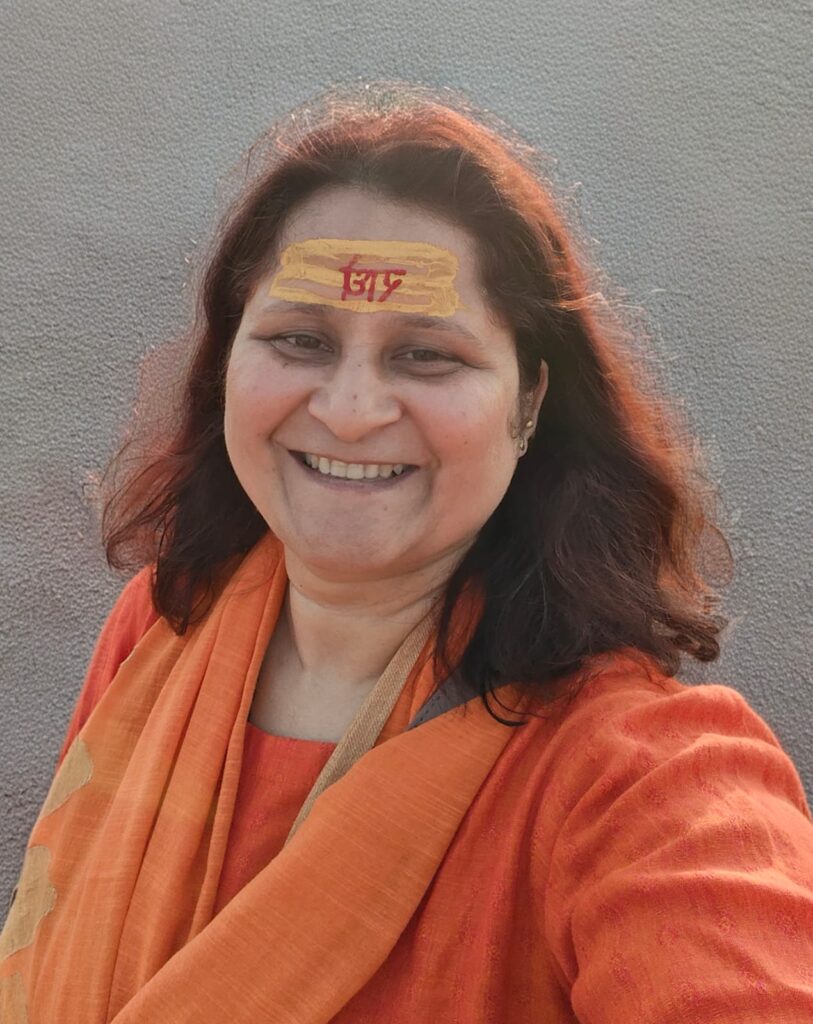
When my father left us, the world did not end, but something very quiet inside me did. It felt like someone had switched off a familiar background sound – a voice that had always been there, even when we weren’t talking. Suddenly, the house was the same, the streets were the same, my work was the same – but I wasn’t. There was a strange loneliness that had nothing to do with how many people were around me. It was the loneliness of “What now?” and “Whom do I talk to about this?” – questions that don’t have quick answers.
In that vacuum, I did what many of us do: I started talking to people. Friends, acquaintances, professionals, “experts” of life. Everyone had a suggestion, a technique, a path. “Do meditation,” one said. “Practice mindfulness,” another added. Someone recommended chanting a name 108 times, another suggested special baths, epsom salts, energy cleansing, journaling, affirmations – the list was long, and strangely familiar. I had already been in rooms where all this was spoken about; it wasn’t new. It was almost like life was handing me a catalogue of inner tools and saying, “Pick one and fix yourself.”
The truth is, I have sat at the feet of many “paths”. I learnt about Transcendental Meditation and Maharishi Mahesh Yogi’s way of touching deeper consciousness. I have experienced the charged halls of Art of Living, breathing in rhythm with hundreds of strangers, feeling the collective rise and fall of chests as Sudarshan Kriya dissolved some invisible weight. I have listened to Sadhguru speak – sometimes live, sometimes through a screen – about how this existence is more than body and mind, and how stillness is possible even in the middle of chaos. Some sessions I attended personally, others I attended like a quiet observer from the corner of my room, through YouTube.
You would think that after so many satsangs, discourses, and meditation practices, I would become “spiritual.” But that word still feels too heavy on my tongue. I am not a seeker of occult powers, miracles, or some secret door to another world. The idea of “occult” never attracted me; it felt like a side road that goes away from responsibility and into fascination. My calling is simpler, and in some ways more demanding – consciousness without drama. Not magic, but clarity. Not escapism, but honest looking.
For me, religion is not about rules, fear, or counting how many times I took a name. It is about responsibility – the courage to stand up when it’s easier to sit down, to lead when it’s easier to follow, and to speak with respect even when I am burning inside. Shiva, in this sense, is less a god in the sky and more a mirror of what a courageous, conscious human could be. Not perfect, but aware. Not detached from life, but deeply engaged with it, without losing inner equilibrium.
When people tell me, “Just meditate, everything will be fine,” I sometimes smile politely. Not because they are wrong – meditation does help many people hold their grief gently and see that emotions rise and fall like waves. It has helped me too, on many days, to sit with my pain without collapsing into it. But grief is not a technical error that you can fix with a three-step method. Losing a parent is not a spiritual project; it is a human heartbreak. The night you cry because you heard their favourite song in a shop is not a “growth opportunity” – it is love remembering itself.
What meditation and mindfulness have given me is not an escape from grief, but a softer way of carrying it. When my mind tells me, “You are alone now,” I have learnt to also notice the breath that continues, the body that still walks, the responsibilities that still exist. I have learnt, slowly, that love does not end when a life ends; it changes shape. Sometimes it becomes a memory that makes you smile in the middle of traffic. Sometimes it becomes a standard you hold yourself to: “Would my father be proud of how I am handling this?”
Shivratri, in this phase of my life, has started to feel different. Earlier, it was a festival on the calendar – fasts, bhajans, images of Shiva-Parvati, long queues at temples. Now, it feels more like a quiet appointment with myself. I no longer see Shiva only as a powerful deity with matted hair and a crescent moon; I see Him as a symbol of that vast consciousness in which my personal story – my father’s death, my loneliness, my work, my dreams – is one small wave in an infinite ocean. That thought doesn’t remove the pain, but it makes the pain less suffocating. If everything is held in a larger field of awareness, then maybe I am not as alone as I feel.
I also think about Futureicons and the kind of life and work I am building. I am very clear that I don’t want it to become a “superpower.” Superpower, to me, smells of dominance, competition, and noise. What I want is evolution – of careers, yes, but also of consciousness, of how we see ourselves and each other. I don’t want to stand on top of a mountain; I want to walk among people and say, “We can live and work differently. We can choose dignity over fear, clarity over confusion.” If Shiva represents the ultimate consciousness, then my work is just a small reflection of that – an attempt to bring a little more awareness into decisions, education, and everyday life.
There are nights when I still feel that old heaviness, when memories of my father come rushing in like an unexpected storm. On those nights, I do not always sit on a mat or chant a mantra. Sometimes, my meditation is just sitting on the edge of the bed, feet on the floor, hand on my heart, and telling myself, “You are here. You are breathing. You are allowed to feel this.” That, too, is a form of Shivratri – staying awake with myself, not running away into distraction.
Maybe that is what my path truly is: not spiritual in a grand, visible way, but quietly conscious. Not obsessed with light and shadows, but committed to living honestly in between them. I may never call myself a yogi or a seeker, but I am learning, slowly, to be a witness – of my grief, my growth, my mistakes, and my small joys. And in that witnessing, there is a taste of the same ocean-like stillness that sages speak of when they talk about Shiva.
If someone asks me today, “What are you doing for Shivratri?” I might say: I am doing what I do every day, but with a little more awareness. I will show up for my responsibilities, I will speak to people with respect, I will work for transformation instead of power, and I will sit, at least for a few minutes, with my eyes closed – not to escape this world, but to feel more fully present in it. That is my way of honouring both my father’s memory and Shiva: by choosing life, again and again, with as much courage and consciousness as I can