

I do this thing where I carry my laptop to a cafe, open a very serious-looking spreadsheet, and then spend most of the time listening to other people’s conversations. As a career coach, I tell myself this is “research.” My sister calls it eavesdropping. We are both right.
Last month, two young people sat at the table next to mine. Early twenties. Friends. Both are clearly out to celebrate something maybe a first salary, maybe a Tuesday.
One of them ordered a coffee that cost ₹500. He did it the way you’d swat a fly. Tapped his phone, didn’t blink, went back to talking.
The other one blinked for both of them.
“Five hundred rupees,” he said slowly, in that voice people use when they’re quietly judging you. “For coffee. Bhai, that’s a full day’s lunch for three people.”
The first one laughed. The second one didn’t.
And in that small, awkward little silence, I quietly closed my serious spreadsheet. Because these two friends same age, same table, same menu, same city were not spending in the same way at all. One of them had just bought something invisible. To the other, it was an event.
Same coffee. Two different kinds of spenders. And the gap between them is the single most useful thing I teach the young people who come to me for career advice.
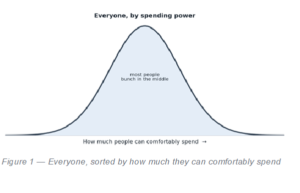
Picture a bell curve (don’t run; it’s friendly)
You’ve seen the shape even if you’ve forgotten the name. A normal probability curve. The bell.
Draw a line for “how much money people can comfortably spend.” A few people sit far on the left, with almost nothing to spare. A few sit far on the right, where money is basically a rounding error. And the huge bulge in the middle is everybody else most of us, most of the time.
Now chop off the two extremes
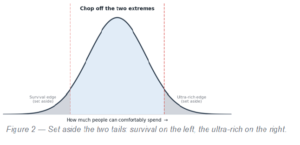
Take a pen and gently cut off both ends.
Cut off the far left the people in pure survival mode, where every rupee is already promised to something. And cut off the far right the tiny sliver who’ll buy a ₹500 coffee and a ₹5 lakh watch with the same shrug. These two extremes are real, and they matter, but they are not where most careers are built. So set them aside for a minute.
What’s left is the middle, about 90% of people
Once you remove those two thin tails, what remains is the fat, busy middle. Roughly 9 out of every 10 people live here call it about 90%. This is the part that actually matters for your career and your customers.
And here’s the part people miss: this middle is not one blob of “average” people. It quietly splits into four kinds of spenders. Notice the word “spenders,” not “classes.” These are not different parts of the economy. They are different ways of reaching for the wallet. The same person can even shift groups over time.
I give them plain names, because plain names are easy to remember.
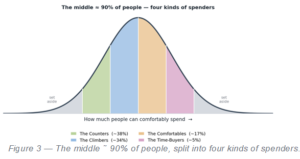
The Counters about 38% of the middle
The careful ones. Smartphones, UPI, big dreams but every rupee gets questioned at the door before it’s allowed to leave. They compare three apps before buying one thing. They wait for the sale like it’s a festival. To a Counter, that ₹500 coffee isn’t a drink. It’s a small crime.
The Climbers about 34% of the middle
Ambitious and digital. They want the good life. They just check the bill twice before agreeing to it. A Climber will happily pay ₹500 for coffee… and then feel a flutter of guilt and silently promise to cook at home all next week. (They won’t.) A ₹5,000 course makes a Climber think. A ₹50,000 anything makes them call their most “financially responsible” friend for permission.
The Comfortables about 17% of the middle
They’ve stopped sweating the small numbers. A ₹500 coffee doesn’t register. They’ll pay for the better seat, the nicer brand, the smoother option not because they’re showing off, but because the extra cost simply isn’t worth thinking about anymore.
The Time-Buyers about 5% of the middle
The right edge of our trimmed curve. They live by one sentence: “I know it costs more, but it saves time.” That one line explains almost everything: ten-minute grocery delivery, premium gyms, house-help apps, and yes, our friend’s ₹500 coffee. To a Time-Buyer, that coffee wasn’t coffee. It was “I don’t feel like standing in a queue today.” They don’t buy the cheapest thing. They buy the done-for-me thing.
Back at the cafe, it was suddenly obvious. The boy who tapped his phone was a time buyer in training. His friend was a counter. And the silence between them was just two kinds of spenders meeting over one cup.
So which spender are you? (no one’s watching except me, apparently.)
Take a second and find yourself on the curve. Most of the young people I coach are Climbers, and being a Climber is honestly a good place to start. You have language, skills, internet, and choices.
But here’s the lesson that the ₹500 coffee dragged out of my own memory while I sat there pretending to work.
When I started out, years ago, I quietly served my own kind of spender. Careful climbers, just like me. People who admired good work but flinched at the price and negotiated every rupee. I worked hard. I stayed broke. And I couldn’t understand why.
The mistake was simple. I was serving my own segment.
If you want your income to grow, the fastest shortcut is this: learn to serve the segment above you.
Not to flatter rich people. Not to become fake. But because the segment above you pays for outcomes, not effort.
The Counters pay for “cheap.” The Climbers pay for “affordable.” The time-buyers just say, “Solve my problem, make it nice, here’s the money.” That last group has bigger budgets, fewer arguments, and far less haggling because they’re not buying your hours; they’re buying their result.
So if you’re freelancing, stop chasing clients who fight you over ₹500. Find the ones who care about the outcome. If you’re learning a skill, go deep enough that someone will gladly pay a premium, not “I can sort of use the tool.” If you’re building anything, build for people who already spend in that category, instead of begging people to spend for the very first time.
You don’t rise by serving people exactly like you. You rise by serving the segment just above you, and slowly, quietly, your own spending changes too.
One honest warning before you go
Whatever group you decide to serve, remember the two ends we chopped off the curve. They didn’t disappear. They’re still there. Real people, full lives.
The view from your own spending always feels like the whole world. It never is. Just because the cafe crowd shrugs at a ₹500 coffee does not mean India is a ₹500-coffee country. It absolutely is not.
So stay ambitious. Aim one group up. Serve people who pay for outcomes. But stay humble enough to remember the rest of the curve, including the friend who’s still doing the math on that lunch for three.
As for the two boys at the next table? They split the bill. And I’m fairly sure the counter is going to bring up that coffee at every single reunion for the rest of their lives.
Honestly, for ₹500, that’s a bargain.
Still figuring out which “segment” to build your career around? That’s exactly the conversation I have with the people I coach. If you want a second pair of eyes on your next move, write to me let’s map it out together.